

A Supreme Court ruling expands presidential powers just as economic reforms finally deliver results—presenting Africa’s largest economy with a familiar dilemma: stability at what cost?
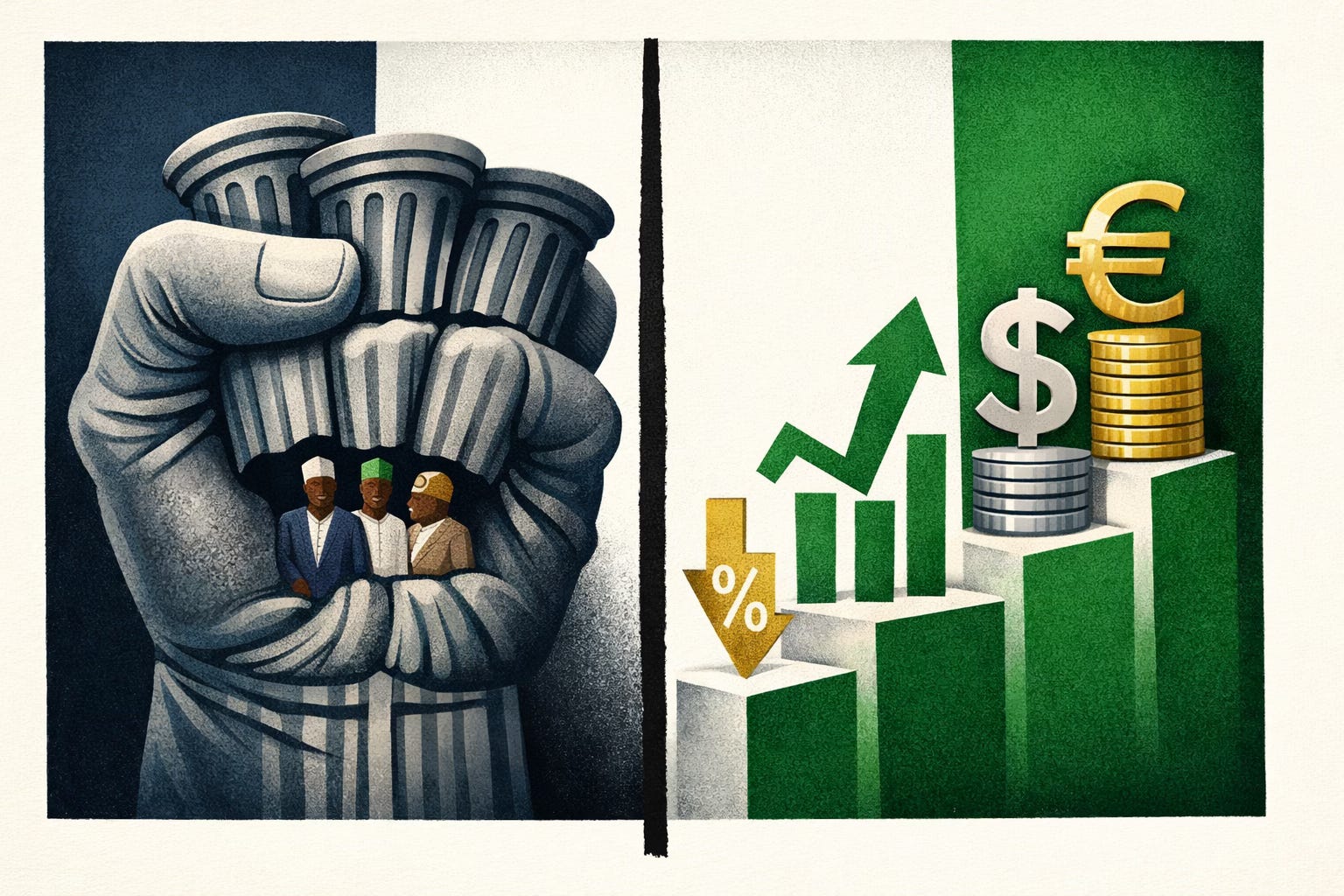
The week of December 10-16, 2025 offered a revealing snapshot of Nigeria’s competing imperatives. Inflation fell to its lowest level in five years, the naira steadied after years of turbulence, and foreign reserves touched a seven-year peak. Yet the same week delivered a Supreme Court ruling that critics warn could transform the presidency into an instrument of constitutional autocracy. For Nigeria’s 220 million citizens, the calculus remains stark: economic stabilisation is proceeding in tandem with political centralisation—and it is unclear whether the two can long coexist.
Politics & Governance
The court gives and the opposition trembles
Emergency powers, expanded
The most consequential development of the week came on December 15th, when the Supreme Court ruled 6-1 to dismiss the suit in SC/CV/329/2025 (filed by Adamawa State and ten other PDP-controlled states), effectively affirming President Bola Ahmed Tinubu’s constitutional authority to declare emergencies in any state. The ruling validated Tinubu’s March 2025 six-month emergency in Rivers State and, by extension, affirmed his power to deploy extraordinary measures to restore order—measures which critics and the lone dissenting justice argue now include the power to suspend elected governors, deputies, and legislators.
Attorney-General Lateef Fagbemi hailed the decision as “a victory for Nigerians and democracy.” The African Democratic Congress offered a blunter assessment: the ruling creates a “constitutional tyrant.” Justice Obande Ogbuinya, in his lone dissent, argued that emergency powers should never extend to removing democratically elected officials. The ruling’s implications reach far beyond Rivers. With Nigeria’s federalism already fraying under decades of centralisation, opposition governors now operate under explicit notice that their tenure depends partly on presidential forbearance.
APC’s one-party dominance deepens
The week’s political choreography suggested Tinubu intends to capitalise on his strengthened position. At a Federal Executive Council meeting on December 10th, he approved firearms for forest guards nationwide and reiterated orders withdrawing police protection from VIPs without presidential clearance—moves that simultaneously address genuine security needs while concentrating coercive power. More telling was Governor Fubara’s December 16th declaration supporting Tinubu’s re-election, delivered while commissioning a road project in Ahoada East. The man Tinubu had suspended mere months earlier now pledged fealty—a tableau that speaks volumes about the new political arithmetic.
The ruling All Progressives Congress (APC) now controls 27 of 36 governors, with the Peoples Democratic Party reduced to just five. Defections continue apace: Rasheed Kashamu, an Ogun State legislator, crossed from PDP to APC on December 16th, citing “irreconcilable differences.” The emerging opposition coalition—featuring former Senate President David Mark as interim ADC chairman and former Osun Governor Rauf Aregbesola as secretary—appears more a collection of displaced politicians than a coherent alternative. APC National Secretary Ajibola Basiru dismissively labelled critics “Internally Displaced Politicians.”
Ambassadors confirmed, federal character violated
The Senate, meanwhile, proceeded with ambassadorial confirmations following two years without envoys in Nigeria’s 109 foreign missions. Three non-career ambassadors were confirmed December 16th, with 64 nominees pending. The list’s most notable feature is its federal character violations: Senator Ali Ndume complained that some states received multiple slots while others received none—a constitutional breach that nevertheless appears destined for approval.
Economy & Business
The numbers finally cooperate
Inflation falls, naira stabilises
Nigeria’s macroeconomic data released this week offered the government its strongest vindication since taking office. November inflation fell to 14.45%—the lowest since October 2020 and the eighth consecutive monthly decline. Food inflation dropped to 11.08%, driven by a strong harvest season, while core inflation hit 18.0%, the lowest since February 2023. The trajectory suggests single-digit inflation may arrive by mid-2026, an outcome unthinkable eighteen months ago when prices were rising at 34%.
The naira has achieved something approaching stability. Trading between ₦1,451 and ₦1,457 per dollar in the official market throughout the week, the currency’s parallel market premium has collapsed to under 3%—down from over 60% a year ago. This convergence represents a quiet triumph of the Central Bank’s reforms under Governor Olayemi Cardoso, even if the exchange rate itself remains historically weak.
Reserves surge, oil output climbs
Foreign reserves provided the week’s headline figure: approximately $46.7 billion, a seven-year high with over ten months of import cover. The drivers are notable. Diaspora remittances have surged 66.7% to roughly $600 million monthly, pushing 2025 totals toward $23 billion—a five-year record. Foreign capital inflows reached $20.98 billion in the first ten months, a 70% increase over all of 2024. Moody’s upgrade to B3 earlier in 2025 and Nigeria’s removal from the FATF grey list have restored confidence that seemed permanently lost.
Oil production offered additional encouragement. NNPC E&P Limited hit 355,000 barrels per day on December 1st—its highest daily output since 1989 and a 52% increase over 2023 averages. The broader production target of 2 million bpd by 2027 now appears achievable rather than aspirational.
Debt and deficits temper optimism
Yet the fiscal picture reveals the reform agenda’s limits. The 2026 budget framework approved by the Senate envisions ₦54.4 trillion ($37.7 billion) in spending against projected revenues of ₦34.33 trillion—a deficit of ₦20.1 trillion financed primarily through borrowing of ₦17.89 billion, a 42% increase over 2025. Debt service will consume ₦15.9 trillion, nearly half of expected revenues. The budget assumes an oil price of $64.85 per barrel and production of 1.84 million bpd—both optimistic. More troubling: 70% of the 2025 capital budget will roll into 2026, with only 30% of planned projects actually funded.
The stock market captured investor enthusiasm: the NGX All-Share Index closed December 15th at 149,437.88 points, up 45.19% year-to-date, with market capitalisation reaching ₦95.27 trillion. The ICT sector led gains, with MTN Nigeria up 135% and NCR Nigeria up an extraordinary 993%.
Security & Defence
Security’s grim arithmetic persists
Churches and checkpoints under attack
The week’s violence struck with particular ferocity in Kogi and Borno states. On December 14th, gunmen attacked an Evangelical Church Winning All congregation in Kogi’s Aaaaz-Kiri community during Sunday services, killing at least one worshipper and abducting 13 people. Security forces killed five attackers. The same day, a suicide bomber killed five soldiers at a military checkpoint in Pulka, Borno State. Kogi Information Commissioner Kingsley Fanwo offered a telling diagnosis: military operations in neighbouring states are pushing bandits toward Kogi—a hydra-headed problem where pressure in one region displaces violence to another.
Troops prevail, civilians pay
The military demonstrated operational competence during the week. On December 12th-13th, troops repelled a major ISWAP assault on Forward Operating Base Mairari in Borno, destroying two vehicle-borne bombs and killing multiple attackers without Nigerian casualties. Operations across the North-West and North-Central neutralised over 25 terrorists and bandits, including an airstrike that killed 11 in Sokoto on December 10th. Yet controversial Nigerian Air Force strikes in Kukawa, Borno on December 14th killed at least five civilian drivers alongside three insurgent vehicles—an incident that occurred hours after the NAF announced a partnership with U.S. experts on civilian harm mitigation.
Tinubu mobilises resources, tensions mount
The St. Mary’s School kidnapping from late November remained unresolved, with 115-165 students and 12 teachers still in bandit captivity despite the December 8th release of 100 children. President Tinubu’s December 10th Federal Executive Council meeting authorised aggressive responses: withdrawing 11,566 police officers from VIP protection for redeployment to conflict zones, arming forest guards nationwide, and launching recruitment of 50,000 new police constables.
Regional tensions complicated the security picture. Following Nigeria’s successful intervention in Benin’s December 7th coup attempt—which saw Nigerian jets strike positions in Cotonou—relations with the Alliance of Sahel States deteriorated further. Eleven Nigerian soldiers detained in Burkina Faso after their C-130 made an emergency landing on December 9th remained in custody through week’s end despite being released from formal detention, their aircraft’s status unclear. The AES placed air defences on “maximum alert” and accused Nigeria of airspace violations, while Foreign Minister Tuggar described ongoing negotiations as “delicate.”
Society & Culture
Society prepares for protest and tournament
Labour mobilises as grievances mount
Nigerian civil society demonstrated its continued capacity for mobilisation. The Nigeria Labour Congress announced a nationwide protest for December 17th, citing insecurity, poverty, the ongoing JOHESU health workers’ strike, and what NLC President Joe Ajaero termed governance failures. The December 10th World Human Rights Day brought smaller #EndBadGovernance protests to Lagos and Abuja, with demonstrators demanding the release of detained activists and the sacking of Police Inspector-General Kayode Egbetokun.
The grievances are substantial. The World Bank reported in October that 139 million Nigerians—approximately 62% of the population—live in poverty. The JOHESU strike that began November 14th continues to paralyse healthcare delivery. ASUU’s October warning strike may resume if renegotiation of the 2009 FGN-ASUU agreement stalls further. The education sector’s crisis persists despite Vice President Kashim Shettima’s announcement that the education budget has grown to ₦3.52 trillion from ₦1.54 trillion in 2023.
Football and film provide distraction
Lighter fare arrived in the form of football. Coach Eric Sékou Chelle announced his 28-man Super Eagles squad for the Africa Cup of Nations in Morocco on December 11th, with training camp opening in Cairo on December 14th. The squad features Victor Osimhen (Galatasaray), Ademola Lookman (Atalanta), and the surprise return of goalkeeper Francis Uzoho. Notable absences include the injured Victor Boniface. Nigeria opens Group C play against Tanzania on December 23rd in Fès, followed by Tunisia and Uganda.
The entertainment industry offered seasonal releases: Funke Akindele’s “Behind The Scenes” and Omoni Oboli’s “Promise Me December” premiered on December 12th, while anticipation builds for Kemi Adetiba’s “King of Boys 3: The Beginning of the End” on Christmas Day. Nigerian cinema is projected to reach ₦15 billion in 2025 revenues, a 58% increase from 2024—evidence that cultural industries continue thriving despite broader economic pressures.
Technology, Infrastructure & Innovation
Digital infrastructure advances amid contradictions
5G expands, basic connectivity struggles
Technology developments reflected both progress and persistent challenges. MTN Nigeria launched unlimited 5G broadband plans on December 11-12th, offering 50 Mbps and 100 Mbps options with a 30-day free trial for router purchasers. The rollout advances 5G adoption, though coverage remains concentrated in Lagos and Abuja, and only about 4 million subscribers—roughly 3% of mobile users—have access to 5G networks.
The Nigerian Communications Commission faced embarrassment when network quality in Abuja deteriorated sharply, attributed to diesel supply disruptions affecting IHS Nigeria’s base stations. The incident exposed the fragility of telecoms infrastructure dependent on backup power in a country where grid electricity remains unreliable. Broadband penetration stood at 48.78% as of June—well below the December 2025 target of 70%.
Private capital targets infrastructure gaps
More promising was the launch of CardinalStone’s ₦500 billion umbrella infrastructure fund on December 16th, Nigeria’s largest such platform, with an initial ₦20 billion infrastructure debt vehicle targeting power, gas, telecommunications, and transport. The UK committed an additional $75 million for infrastructure development through the UK-Nigeria Infrastructure Advisory Facility. These private and bilateral flows may prove more consequential than government capital spending, given the budget’s constrained fiscal space.
NITDA’s iHatch programme announced winners on December 12th: Interface Africa (clean energy fintech) received $15,000, Ahioma (e-commerce) $12,000, and Linia Finance (fintech) $10,000—modest sums but evidence of an incubation ecosystem slowly maturing. The agency also launched Digital Literacy for All campaigns in Kano and Bauchi, targeting 70% digital literacy by 2027.
International Relations
ECOWAS pivots while regional tensions simmer
Security funding and leadership transitions
The 68th ECOWAS Summit in Abuja on December 14th delivered the week’s most significant diplomatic outcomes. Leaders approved $2.85 million each for Nigeria, Benin, Côte d’Ivoire, Ghana, and Togo from the Regional Security Fund to address terrorism spillover from the Sahel. The Summit instructed urgent operationalisation of a regional counter-terrorism brigade—recognition that the AES countries’ departure has created a security vacuum ECOWAS must fill or face.
Nigeria secured the Vice President position in the 2026-2030 ECOWAS Commission leadership, with Senegal taking the presidency. Dr. Habibu Yaya Bappah was sworn in as Commissioner for Internal Services. The bloc endorsed Ghana’s President John Dramani Mahama as its candidate for African Union Chair in 2027—a diplomatic win for Accra though one whose prospects at the continental level remain uncertain.
Tuggar’s active week of bilateral engagement
Foreign Minister Tuggar’s week was notably active. He met Beninese counterpart Olushegun Adjadi Bakar on December 11th to coordinate post-coup responses, telling journalists that “whatever happens in one country inevitably triggers ripple effects in the other. A coordinated regional response is no longer optional.” He met US Ambassador Richard Mills Jr. on December 15th amid ongoing discussions about expanded counterterrorism cooperation and Washington’s October designation of Nigeria as a “Country of Particular Concern” for religious persecution. Tuggar also hosted Gambian Foreign Minister Sering Modou Njie, reviewing preparations for a bilateral Joint Commission in early 2026.
The Week Ahead
The week ahead holds multiple flashpoints
The Super Eagles face Egypt in a pre-AFCON friendly on December 16th in Cairo before flying to Morocco on December 18th. The tournament, beginning December 21st, will dominate public attention through early January.
The scheduled December 17th NLC protest presents the week’s most immediate uncertainty. Labour’s grievances—security failures, healthcare strikes, poverty—resonate broadly, and previous #EndBadGovernance protests in August 2024 demonstrated capacity for nationwide mobilisation. Government responses to past protests have included arrests and restrictions on media, raising concerns about potential heavy-handedness.
Economically, the final 2025 debt auctions—₦825 billion in bonds and Treasury bills—conclude December 17-18th, testing investor appetite before year-end. Banking recapitalisation continues toward the March 31, 2026 deadline, with 16 of 36 banks compliant and several rights issues pending. Markets will watch for any year-end policy surprises from the CBN, though with inflation declining and reserves strong, the central bank appears inclined toward continuity.
The detained Nigerian soldiers in Burkina Faso remain a diplomatic wild card. Resolution likely requires quiet negotiations rather than public confrontation, but the AES’s hardening posture—including instructions to scrutinise Nigerian products—suggests the broader relationship is deteriorating even as ECOWAS attempts to maintain engagement channels.
Nigeria ends 2025 in considerably better macroeconomic shape than it began, a genuine achievement after years of policy drift and currency crises. The consolidation of presidential power through both judicial affirmation and political manoeuvring has created a more centralised governance structure—efficient, perhaps, but freighted with risks for democratic accountability. The security situation remains the irreducible challenge: no amount of economic stabilisation compensates for citizens who cannot worship, farm, or send children to school without fear of abduction or death.
The government’s wager is that improved economic conditions will eventually translate into better security outcomes and political legitimacy. That wager has precedent—Nigeria’s previous democratic consolidation in the 2000s proceeded alongside oil boom prosperity. Whether it can work when borrowed money substitutes for oil revenues, and when 62% of the population lives in poverty, is the question 2026 will begin to answer.