

Nigeria flexed its regional muscles this week, deploying fighter jets to crush a coup in Benin while its ruling party completed a remarkable consolidation of power at home. The week’s events revealed a nation simultaneously projecting strength abroad and grappling with persistent security crises within its borders.
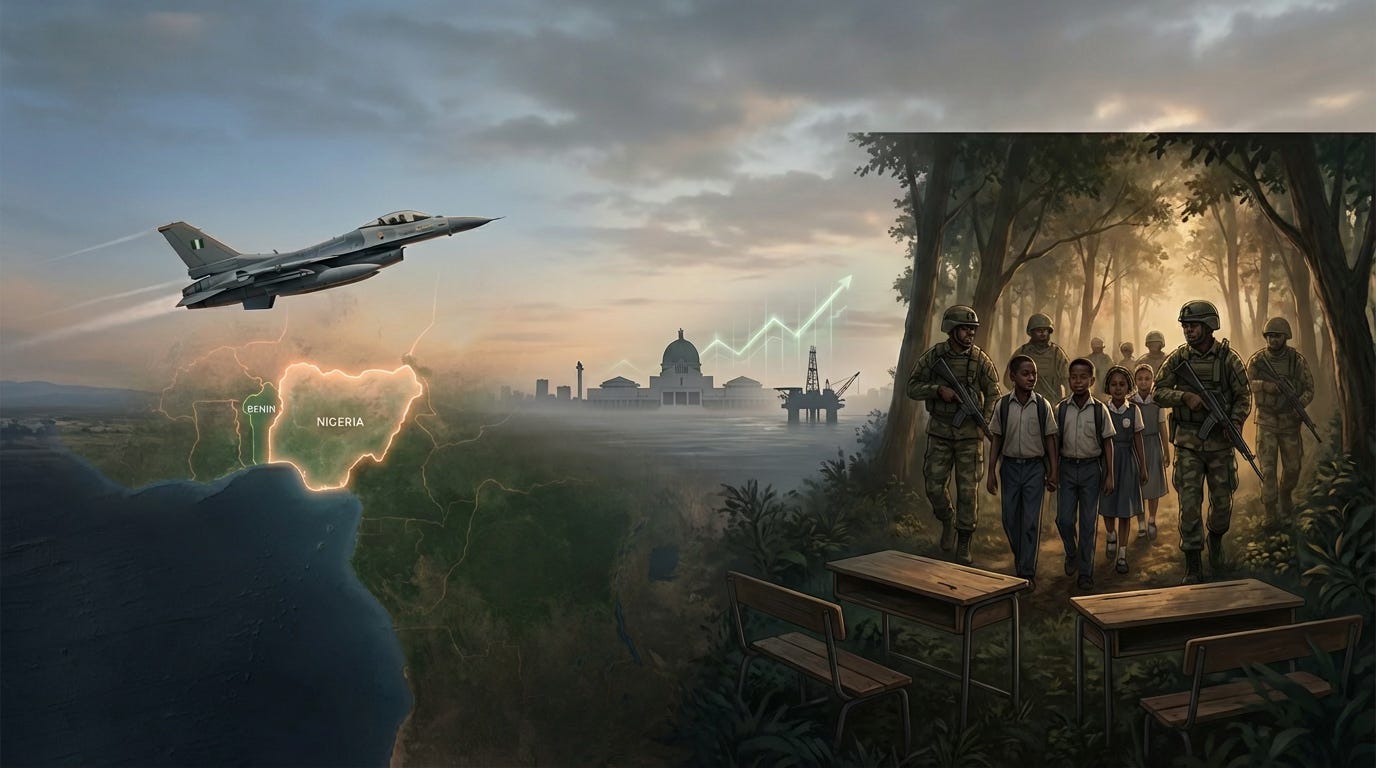
President Bola Tinubu’s administration demonstrated both its regional ambitions and domestic vulnerabilities in a week that saw Nigerian warplanes defend democracy in Cotonou, 100 kidnapped schoolchildren rescued from bandits, and the opposition’s last South-South governor defect to the ruling party. The juxtaposition is instructive: Africa’s most populous nation can mobilize military force across borders within hours, yet remains unable to guarantee the safety of students in its own schools.
Politics & Governance
A party that swallows its opposition
Governor Siminalayi Fubara of Rivers State joined the All Progressives Congress (APC) on December 9, completing the ruling party’s conquest of the oil-rich South-South region—a zone that has been a historic stronghold for the opposition People’s Democratic Party (PDP) since Nigeria’s return to democracy in 1999. The defection, announced at a stakeholders’ meeting in Port Harcourt following a closed-door session with President Tinubu, brought to four the number of South-South governors who have abandoned the PDP this year alone.
“If President Tinubu had not intervened, there wouldn’t be a Siminalayi Fubara today,” the governor declared, referencing the president’s role in mediating his bitter feud with his predecessor and political godfather, Nyesom Wike. The APC now controls 26 of Nigeria’s 36 governorships, while the PDP has been reduced to six—a remarkable reversal from the party that held power federally for 16 uninterrupted years until 2015.
The week’s defection wave extended beyond Rivers. In the National Assembly, Representative Mansur Musa Jega of Kebbi State crossed to APC, citing “persistent internal crises” within the PDP. In Zamfara, the PDP chairman himself switched allegiance, declaring his former party “dead” in the state. Critics warn of creeping one-party dominance; APC officials dismiss such concerns as sour grapes. “These defections are voluntary and driven by support for the administration’s policies,” presidential adviser Daniel Bwala insisted. Perhaps. But the gravitational pull of federal patronage in Nigeria’s winner-takes-all politics makes such moves entirely rational—and the PDP’s organisational dysfunction has made them inevitable.
A new hand on the sword
General Christopher Musa (retired), sworn in as Defence Minister on December 4, wasted no time setting expectations. The former Chief of Defence Staff promised to investigate the troop withdrawal that preceded the November 17 kidnapping of 26 schoolgirls in Kebbi State, probe the killing of Brigadier General Musa Uba by terrorists, and review all military operations “from day one.” His Senate confirmation hearing was notable for its candour: Musa endorsed border fencing with Cameroon (approximately 1,900 km) and Niger (roughly 1,500 km), proposed ending all ransom payments, and identified poverty and illegal mining as root causes of insecurity.
The National Assembly, meanwhile, passed resolutions demanding the death penalty for kidnappers and the public naming of terrorism financiers—measures that play well politically but have historically proven difficult to enforce. More consequential may be the renewed push for state police: the Northern Governors’ Forum, meeting in Kaduna, unanimously endorsed decentralised policing as “critical and effective,” adding momentum to constitutional amendments that have languished for years.
Economy & Business
A fortress of foreign reserves
Nigeria’s external reserves reached $45.04 billion by December 4—a six-year high that provides the Central Bank with substantial firepower to defend the naira through the holiday season. The currency traded in a remarkably tight band of ₦1,445-1,465 per dollar on the official market, while the parallel market premium narrowed to just ₦18-40, down from triple digits in previous years. The convergence suggests the CBN’s exchange rate reforms, however painful, are achieving their intended effect.
Inflation continued its descent, falling to 16.05% in October—the lowest since March 2022 and the seventh consecutive monthly decline. Food inflation dropped even more sharply, to 13.12% from 16.87%, as the harvest season delivered relief to consumers battered by two years of price shocks. The caveat: January’s rebasing of the Consumer Price Index from 2009 to 2024 makes comparisons tricky, and the lived experience of ordinary Nigerians remains one of persistent hardship.
Black gold flows again
NNPC Exploration & Production recorded daily output of 355,000 barrels—its highest since 1989—while national crude production averaged 1.64 million barrels per day in the third quarter, up from just over 1 million barrels during the theft-plagued nadir of 2022. The Nigerian Upstream Petroleum Regulatory Commission launched a new licensing round offering 50 blocks expected to attract $10 billion in investment and add 400,000 barrels per day when fully operational.
NNPC Limited reported record profits of ₦5.4 trillion for 2024, a 64% increase that reflects both higher production and the end of the ruinous petrol subsidy regime. Nigerian benchmark crudes traded above $65 per barrel, supported by geopolitical tensions including Ukrainian strikes on Russian energy infrastructure.
Markets recover their nerve
The Nigerian Stock Exchange staged a decisive rebound after November’s brutal ₦6.5 trillion selloff, with the All-Share Index climbing 2.45% for the week. Industrial goods led the recovery (+7.38%), followed by banking (+3.20%). The catalyst for November’s “Black Tuesday” meltdown—a proposed capital gains tax increase on equity investments from January 2026—remains unresolved, with market participants pressing for a policy rethink.
Banks continue mobilising capital ahead of the CBN’s March 2026 recapitalisation deadline, with over ₦2.8 trillion raised sector-wide. The Unity Bank-Providus Bank merger, supported by a ₦700 billion CBN facility, may be the first of several consolidations as smaller lenders scramble to meet new minimum capital requirements.
Security & Defence
A hundred children freed, over one hundred more await
Security forces rescued 100 students from St. Mary’s Catholic School in Niger State on December 7-8, more than two weeks after bandits seized over 300 pupils and 12 teachers from the institution. The children, aged 10 to 17, were recovered from Wawa Forest in a joint operation coordinated by the National Security Adviser’s office. President Tinubu hailed the rescue but acknowledged the obvious: 115 students and 12 teachers remain in captivity, joining the estimated 7,000 Nigerians held hostage across the country in the last year.
The rescue offered a rare piece of good news amid an otherwise grim security landscape. In Kogi State, gunmen attacked a church during Sunday service, abducting the pastor and several congregants—the second such incident in the area within 24 hours. In Kwara, a traditional ruler was kidnapped with demands of ₦150 million; two Chinese construction supervisors were seized near the Benin border. The pattern is depressingly familiar: an average of 490 people were kidnapped in a 13-day period ending December 1, according to local press tallies.
The neighbourhood policeman
Nigeria’s most consequential security action of the week occurred beyond its borders. When soldiers in Benin Republic attempted to overthrow President Patrice Talon on December 7, Nigerian Air Force jets were scrambled within hours at the Beninese government’s request. Ground forces followed. By evening, the coup attempt was crushed, 14 soldiers arrested, and Talon was addressing the nation from a secured position.
President Tinubu framed the intervention as fulfilling Nigeria’s obligations under the ECOWAS Protocol on Democracy and Good Governance. “Today, the Nigerian armed forces stood gallantly as a defender and protector of constitutional order,” he declared. ECOWAS deployed additional troops from Sierra Leone, Côte d’Ivoire, and Ghana; at the bloc’s Mediation and Security Council meeting on December 9, Nigeria received a standing ovation.
The operation showcased capabilities that Nigeria has struggled to deploy effectively within its own territory. It also highlighted a constitutional ambiguity: critics argued that deploying troops for combat abroad without prior National Assembly approval constituted an impeachable offence. The Senate subsequently provided retrospective authorisation—unanimously and within four hours.
The Americans come calling
A Congressional delegation led by Representatives Mario Díaz-Balart and Riley Moore met National Security Adviser Nuhu Ribadu on December 7, advancing the security partnership formalised during Ribadu’s Washington visit in November. The meetings produced commitments to a joint task force, enhanced intelligence sharing, and—notably—a shift in American rhetoric.
“Things are moving in the right direction,” Representative Moore declared, praising the government’s rescue of the kidnapped students and Tinubu’s declaration of a security state of emergency. The Trump administration had designated Nigeria a “Country of Particular Concern” for religious freedom violations just weeks earlier; the conversion from confrontation to cooperation represents a diplomatic win for Abuja.
Society & Culture
The perennial campus crisis
The Academic Staff Union of Universities (ASUU) and the federal government faced a tense standoff after ASUU’s November 29 ultimatum expired, but a total shutdown appears to have been averted. Following intense negotiations, ASUU reportedly accepted the government’s improved offer of a 40% salary increase—a significant jump from previous proposals, though it remains to be seen if it fully satisfies the union’s broader base.
While this breakthrough addresses immediate wage concerns, tension remains over unresolved issues, including the payment of withheld salaries from the 2022 strike, promotion arrears dating back four years, and a fundamental renegotiation of the 2009 funding agreement. With the precedent of two-decade-old disputes and broken promises, trust remains fragile. Nigerian universities have lost years of academic time to strikes since 2000; another prolonged shutdown would damage a generation already scarred by COVID disruptions.
Eagles prepare, captain departs
The Super Eagles’ preparations for the Africa Cup of Nations have shifted directly to Morocco (host nation) after the planned camp in Cairo was cancelled due to FIFA scheduling conflicts. However, the mood remains dampened by William Troost-Ekong’s sudden retirement from international football. The captain’s departure leaves a defensive void as Nigeria prepares for Group C matches against Tanzania (December 23), Tunisia, and Uganda. Coach Eric Chelle faces intense pressure to rebuild his back line around Calvin Bassey and Semi Ajayi while seeking redemption for his team’s failure to qualify for the 2026 World Cup—a humiliation that has placed his own tenure under heavy scrutiny.
Afrobeats’ relentless march
Apple Music crowned Fola its “Face” of the “Best of 2025 Afrobeats Hits” playlist after his debut album “Catharsis” achieved significant chart success—a dominance that would have been unimaginable even five years ago when the genre was still fighting for international recognition. Burna Boy collected another Grammy nomination, for “Higher” in the Best African Music Performance category, while Asake announced a continental tour including Lagos, Nairobi, and Abidjan. The industry’s commercial success offers a counterpoint to Nigeria’s governance challenges: its creative economy requires no subsidy removal or CBN intervention, merely a smartphone and talent.
A chieftaincy and a controversy
First Lady Oluremi Tinubu received the title “Yeye Asiwaju Gbogbo Ile Oodua” from the Ooni of Ife on December 7—a significant honour in Yoruba tradition. The ceremony was overshadowed by an awkward exchange in which Mrs. Tinubu asked Osun State Governor Ademola Adeleke to stop singing and proceed with his prepared remarks. Opinions divided predictably: critics accused her of bullying an elected official; defenders noted she addressed him directly rather than through intermediaries. The incident illustrated the ambiguous constitutional status of Nigeria’s first lady—a position with considerable influence but, as activist lawyer Maduabuchi Idam observed, “no foundation in Nigerian law.”
International Relations
West Africa’s indispensable nation
Nigeria’s intervention in Benin cemented its position as ECOWAS’s security guarantor—a role it has played intermittently since the Liberian civil wars of the 1990s. The speed of response was notable: fighter jets were in Beninese airspace within hours of the coup announcement, demonstrating command-and-control capabilities that had been questioned after years of counterinsurgency struggles at home.
ECOWAS Commission President Omar Touray declared the region in a “state of emergency” on December 9, citing 7.6 million forcibly displaced West Africans and over one million refugees. The declaration acknowledged what has become increasingly obvious: the coup contagion that spread through Mali, Burkina Faso, Guinea, and Niger between 2020 and 2023 remains a threat to the region’s remaining democracies.
The Sahel standoff
Relations with the Alliance of Sahel States—the military juntas governing Mali, Burkina Faso, and Niger—took a confrontational turn after a Nigerian Air Force C-130 made an emergency landing in Burkina Faso on December 8. The Nigerian military attributed the landing to a technical fault during a ferry mission to Portugal; the AES condemned it as an “unfriendly act” and airspace violation, detaining 11 Nigerian personnel and placing air defences on “maximum alert.”
The incident highlighted the delicate position Nigeria occupies between its ECOWAS obligations and its practical need to manage relations with neighbours who have rejected the bloc’s authority. Foreign Minister Yusuf Tuggar’s visit to Niger earlier in the week had signalled a thaw; the Burkina Faso standoff demonstrated how quickly temperatures can rise.
Diplomatic diversification
President Tinubu received credentials from 21 ambassadors and high commissioners on December 4, including envoys from Japan, Turkey, India, and Iran—a routine ceremony that nonetheless reflected Nigeria’s efforts to diversify partnerships beyond traditional Western allies. French President Emmanuel Macron called Tinubu on December 7 to discuss security cooperation, pledging training and intelligence support; a Nigeria-Saudi Arabia defence pact was sealed on December 9, adding another strand to Abuja’s web of military partnerships.
Foreign capital continues flowing: $14.78 billion entered Nigeria in the first eight months of 2025, up 118% year-on-year. But the composition troubles economists—86% was portfolio investment, compared to just 2.9% foreign direct investment. Hot money chasing naira-denominated yields is welcome but fickle; productive capital that builds factories and creates jobs remains elusive.
The Week Ahead
December 10-23: Rivers State government commissions ten major infrastructure projects, symbolising the fruits of political reconciliation with the federal government.
December 14: Super Eagles camp expected to open in Morocco (shifted from Cairo) ahead of AFCON 2025; the squad will be trimmed from 54 to 28 players.
December 15: NNPC Group CEO Bayo Ojulari appears before the House Public Accounts Committee to account for 2021 expenditures—a hearing that could reveal uncomfortable details about the corporation’s pre-reform finances.
December 15-21: “Motherland 2025” diaspora festival in Abuja and Lagos, targeting investment in technology, real estate, and healthcare sectors.
The paradox of Nigerian power was on full display this week: a nation capable of projecting military force across borders within hours, yet unable to secure a Catholic school in its own northwest. The rescue of 100 children offered a moment of relief; the 115 or more who remain hostage serve as a reminder of unfinished business. As the year closes, the Tinubu administration has consolidated political dominance, stabilised the currency, and reasserted regional leadership. Whether these achievements translate into security for ordinary Nigerians—farmers, students, worshippers—remains the question that will define its legacy.