

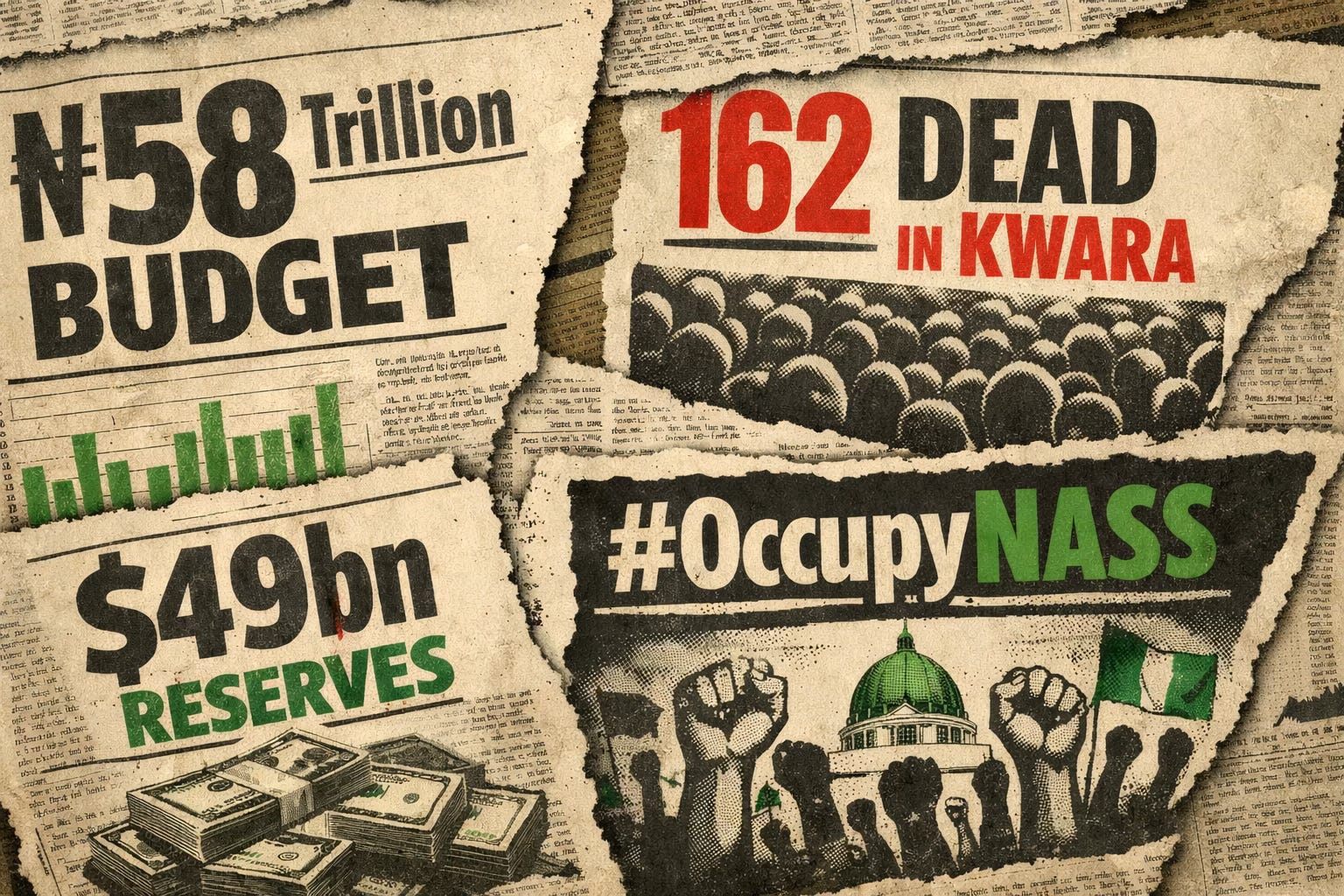
Nigeria’s contradictions were on full display during the week of February 4–10. The stock market smashed records, foreign reserves approached $49 billion, and the naira clawed back ground — yet 162 villagers lay dead in Kwara State after the country’s deadliest jihadist massacre in a decade. Lawmakers who had just passed the world’s largest black-nation budget — ₦58.47 trillion — found themselves barricaded inside parliament by angry citizens demanding they protect the integrity of the ballot. President Bola Tinubu simultaneously hosted America’s top Africa general and unveiled a five-year development plan, projecting a confidence that events on the ground seemed determined to undermine. What emerged was a portrait of a country sprinting forward on some fronts while lurching backwards on others — and a political class forced, at least briefly, to reckon with the gap.
Table of contents
Politics and governance
The Senate’s electoral sleight-of-hand
Peter Obi storms the gates
A tactical retreat
₦58 trillion: Africa’s biggest budget advances
Tinubu’s five-year vision
Economy and business
Cardoso’s $49 billion triumph
Stock market hits record highs
But the real economy stumbles
NNPC throws in the towel
Dangote’s pricing puzzle
Security and defence
162 dead in Kwara’s jihadist nightmare
The insurgency spreads west
Operation Savannah Shield launched
A nation under siege
Rare good news: 183 hostages freed
Technology, infrastructure, and innovation
Fintech regulation comes of age
The power sector’s persistent pain
Green shoots: mini-grids and rail
International relations
America’s top Africa general comes calling
Remi Tinubu’s Washington moment
Multilateral confidence—with caveats
Tsamiya-Kamba corridor
Colonial ghosts: the £420 million ruling
Society and culture
Fela’s posthumous Grammy glory
Lookman lights up Madrid
IPOB cancels the Monday lockdown
The week ahead
Inflation data and the MPC countdown
FCT elections: the final stretch
Unfinished business
Politics and governance
The Senate’s electoral sleight-of-hand
The week’s dominant political drama began on February 4, when the Senate passed 155 clauses of the Electoral Act 2022 (Repeal and Re-enactment) Amendment Bill — and quietly gutted the provision mandating real-time electronic transmission of results from polling units. Senate President Godswill Akpabio insisted the change was merely semantic — swapping “transmission” for “transfer” — but nobody was buying it. By February 5, the PDP, NNPP, and African Democratic Congress had issued a rare joint condemnation. Former Vice-President Atiku Abubakar called it a democratic setback. Civil society coalitions — including the 70-member Nigeria Civil Society Situation Room — accused the Senate of “betraying public trust.”
Peter Obi storms the gates
The backlash crystallized on February 9 when former presidential candidate Peter Obi led hundreds of protesters to the gates of the National Assembly complex under the banner #OccupyNASS. He was joined by activist Omoyele Sowore, former APC stalwart Rotimi Amaechi (who brought his doctor son), and rights campaigner Aisha Yesufu. Heavy deployments of police, army, and civil defense corps sealed the complex — a show of force that only amplified the optics of a ruling party under siege. Even Nasir El-Rufai, the former Kaduna governor now in the ADC, pledged solidarity from abroad.
A tactical retreat
By February 10, the Senate convened an emergency session and re-amended Section 60(3) to permit electronic transmission to INEC’s IReV portal, with a fallback to manual forms during network failure. A 12-member conference committee was constituted to harmonize differences with the House of Representatives. Akpabio indicated the bill would reach Tinubu’s desk within days. The reversal was a rare instance of street pressure bending legislative outcomes — though sceptics note the “network failure” caveat leaves ample room for discretion in rural areas where connectivity is weakest and rigging most tempting.
₦58 trillion: Africa’s biggest budget advances
In parallel, the ₦58.47 trillion 2026 budget — tagged the “Budget of Consolidation” — passed second reading in both chambers during the week. The House approved it on February 5 before Speaker Tajudeen Abbas declared a two-week recess for committee-level defence; the Senate followed on February 10, with a target passage date of March 17. The numbers are eye-catching: ₦5.41 trillion for security, ₦3.56 trillion for infrastructure, and a deficit of ₦23.85 trillion — roughly 41% of total spending financed by borrowing. Senate Appropriations Chairman Solomon Adeola flagged a discrepancy between Tinubu’s stated figure (₦58.18 trillion) and the actual bill (₦58.47 trillion), a detail that captured a persistent sloppiness in fiscal presentation.
Tinubu’s five-year vision
Meanwhile, the Second National Economic Council Conference (February 9–10) saw Tinubu unveil his Renewed Hope National Development Plan 2026–2030, built on five pillars: economic diversification, human capital, subnational competitiveness, private-sector-led growth, and climate resilience. Vice-President Kashim Shettima struck a populist note, insisting “a child born in Lafia must have the same chance of thriving as one born in Lagos.” The plan’s ambitions will be measured against a more revealing development: the Nigeria Revenue Service reported ₦28.3 trillion collected in 2025 — a 30% increase — but still well short of the ₦40.7 trillion targeted for 2026.
Economy and business
Cardoso’s $49 billion triumph
The economic data pouring out of the NEC Conference was, by Nigerian standards, remarkable. CBN Governor Olayemi Cardoso disclosed that gross external reserves had reached $49 billion as of February 5 — a near-sevenfold increase from the $3 billion net figure he inherited. The naira firmed to ₦1,354.90/$ on the official NFEM window by February 9, its strongest since May 2024, while the parallel-market premium collapsed to approximately 6–7%, down from over 16% months earlier. Cardoso made a historic claim: the CBN is now a net buyer of foreign exchange, rather than a seller desperately defending the currency.
Stock market hits record highs
The Nigerian Exchange had an electrifying week. The All-Share Index surged to an all-time high of approximately 173,952 points by February 9, a weekly gain of nearly 4% — the strongest bullish run of 2026. Market capitalization swelled to ₦111.6 trillion (roughly $82 billion). Oil and gas stocks led, with the sectoral index up 10.88%, driven by Aradel Holdings and Seplat Energy. Banking shares gained 3.57% as the March 31 recapitalization deadline approached, concentrating investor minds on which institutions would merge and which would survive.
But the real economy stumbles
Yet warning signs flickered beneath the headlines. The Stanbic IBTC/S&P Global PMI fell to 49.7 in January — the first contraction reading since the survey began in 2014, ending a 13-month expansion streak. Wholesale and retail demand stalled; input costs climbed. The disconnect between surging asset prices and softening real-economy activity echoes a familiar pattern in emerging markets where capital-market euphoria outruns the lived experience of consumers.
NNPC throws in the towel
On the energy front, the 9th Nigeria International Energy Summit (February 4–5) produced a startling confession from NNPC CEO Bayo Ojulari: the country’s four state-owned refineries — with combined capacity of 445,000 barrels per day — were shut because they generated “monumental losses” at 50–55% utilisation, despite ₦13.2 trillion ($9.7 billion) invested over the years. NNPC is now courting foreign equity partners, including a Chinese petrochemical firm, to take stakes.
Dangote’s pricing puzzle
Ojulari credited the Dangote Refinery (650,000 bpd) with providing “critical breathing space.” Dangote, for its part, cut its PMS gantry price to ₦774 per litre on February 10 — though retail prices nationwide still range from ₦817 to ₦905, and imported petrol landing costs (₦721.80/litre) remained cheaper than Dangote’s gate price, raising awkward questions about the refinery’s cost competitiveness.
Security and defence
162 dead in Kwara’s jihadist nightmare
The week’s gravest development was the massacre of at least 162 people in Woro and Nuku villages, Kaiama Local Government Area, Kwara State, on the night of February 3–4. Attackers demanded villagers abandon the Nigerian constitution for their version of sharia; when the Muslim-majority communities refused, militants opened fire, bound victims’ hands, slit throats, and burned homes. Amnesty International described it as a “stunning security failure.” The Critical Threats Project at the American Enterprise Institute labelled it the deadliest jihadist attack outside the northeast to date — and the deadliest of the decade.
The insurgency spreads west
The perpetrators’ identity remains contested. Local officials pointed to Lakurawa, an IS-affiliated group, but analysts at the Hudson Institute assessed Boko Haram’s “Sadiku faction” — whose leader Bakura Doro had signed warning letters to villages weeks earlier — as more probable. The geographic significance is unmistakable: Kwara State lies hundreds of kilometres west of the traditional northeastern insurgency zone, confirming fears of jihadist expansion into central and western Nigeria. At least five distinct armed-group categories — Boko Haram (JAS), ISWAP, Lakurawa, JNIM, and criminal bandits — are now active simultaneously, competing for territory and driving geographic sprawl.
Operation Savannah Shield launched
President Tinubu ordered the deployment of an army battalion and launched Operation Savannah Shield on February 5 to flush out enclaves in Kwara and Niger States. VP Shettima visited the affected communities on February 7. But the sheer breadth of violence across multiple states underscored the military’s overstretched posture.
A nation under siege
On February 7, gunmen attacked a Catholic priest’s residence in Kauru, Kaduna State, killing seven people (including two soldiers and a police officer) and abducting Father Nathaniel Asuwaye along with ten others. Pope Leo XIV expressed condolences during Sunday’s Angelus. In Benue, nine gunmen in military uniforms ambushed a commercial bus on February 8, killing one and abducting 15 passengers. Across Plateau, Benue, and Kaduna, more than 90 people were kidnapped during the week.
Rare good news: 183 hostages freed
A rare bright spot: all 183 worshippers abducted from churches in Kurmin Wali, Kaduna State, on January 18 were confirmed freed by February 6 — though analysts suspect ransom payments remain the norm, and the industrial scale of abductions (hundreds of victims processed weekly) points to a self-sustaining criminal economy.
Technology, infrastructure, and innovation
Fintech regulation comes of age
The Central Bank of Nigeria released its landmark fintech policy blueprint during the week — a comprehensive framework titled “Shaping the Future of Fintech in Nigeria” that signals a shift from laissez-faire expansion to institutional design. Key provisions include a single regulatory window for fintechs, Compliance-as-a-Service utilities, and cross-border licensing pilots with Ghana, Kenya, Senegal, and South Africa. The document acknowledged that 88% of fintech operators say compliance costs materially constrain innovation, with a third facing product-launch timelines exceeding one year. Nigerian startups raised over $520 million in equity in 2024; the new framework aims to sustain that momentum through regulatory clarity rather than regulatory absence.
The power sector’s persistent pain
Physical infrastructure told a less encouraging story. The national power grid’s persistent instability — it collapsed twice in late January — remains a structural drag. An estimated 7-million-meter gap hobbles the distribution system, and Nigerians spent approximately ₦16 trillion on self-generation in 2023. The government’s Presidential Metering Initiative secured ₦28 billion in NERC-approved disbursements to distribution companies, but progress is incremental against a deficit measured in millions of units.
Green shoots: mini-grids and rail
On the brighter side, Nigeria’s decentralized energy push is yielding results: over 120 mini-grid projects were completed in the past 18 months under the Nigeria Electrification Project (NEP), successfully supplying reliable power to more than 90,000 households and small businesses. Simultaneously, the Kaduna-Kano standard gauge railway—a critical artery for northern commerce—remains on schedule for its December 2026 commissioning, representing a rare point of steady progress in the nation’s transport infrastructure.
International relations
America’s top Africa general comes calling
The week’s most symbolically charged diplomatic event was the February 8 visit of AFRICOM Commander General Dagvin Anderson to Abuja — the first such engagement since the December 2025 US-Nigerian joint airstrikes against terrorist positions in Sokoto State and the subsequent deployment of US military advisers. Anderson met the full Nigerian security establishment behind closed doors. The visit underscored a deepening security partnership, though Nigeria is walking a tightrope: accepting American intelligence and kinetic support while insisting US forces operate only in advisory roles, and managing domestic sensitivities around sovereignty.
Remi Tinubu’s Washington moment
First Lady Oluremi Tinubu performed a different kind of diplomatic mission at the National Prayer Breakfast in Washington on February 5, where President Trump publicly recognised her as a pastor — a calculated move to counter the “Christian persecution” narrative that has strained bilateral relations since Trump’s redesignation of Nigeria as a Country of Particular Concern. Deputy Speaker Benjamin Kalu called it “a masterclass in soft power diplomacy.”
Multilateral confidence—with caveats
On February 5, Finance Minister Wale Edun held strategic talks with World Bank Managing Director Anna Bjerde in Abuja, reaffirming multilateral confidence in Nigeria’s reform trajectory.
The United States extended the AGOA trade preference — but only through December 2026, a notably short horizon compared to the previous 10-year renewal, creating uncertainty for Nigeria’s largest duty-free access channel to the US market.
Tsamiya-Kamba corridor
In a pragmatic shift, Tinubu ordered the reopening of the Tsamiya-Kamba corridor on February 9, unblocking some 2,000 trucks transiting from Cotonou to Niger — a quiet normalisation of relations with Niamey’s military government.
Colonial ghosts: the £420 million ruling
The Enugu High Court ruling on February 6 ordering the UK to pay £420 million in reparations for the 1949 Iva Valley coal mine massacre — £20 million per family of the 21 miners killed by colonial police — was symbolically potent if practically unenforceable. London said it had not been formally notified. The ruling lands in a global moment when reparations debates are intensifying, and even its symbolic weight matters.
Society and culture
Fela’s posthumous Grammy glory
Two developments bookended the cultural landscape. Afrobeat pioneer Fela Anikulapo Kuti became the first African artist to receive a Grammy Lifetime Achievement Award, honoured posthumously on January 31 alongside Cher, Whitney Houston, and Carlos Santana. The reverberations carried through the week: on February 7, his sons visited his grave to offer sacrifices; on February 8, the US Embassy publicly hailed the recognition. For a country whose soft power increasingly outpaces its hard power, the award was a moment of collective pride — a reminder that Nigeria’s greatest export may be its culture.
Lookman lights up Madrid
Nigerian football offered its own drama. Ademola Lookman, fresh from a €40 million transfer to Atletico Madrid, scored on his Copa del Rey debut on February 6 — a goal and an assist in a 5–0 demolition of Real Betis. The signing generated 600,000 new social media followers for the Spanish club within 72 hours. Meanwhile, Victor Osimhen netted his 200th career goal for Galatasaray on February 8, and the NFF opened contract extension talks with Super Eagles coach Eric Chelle on February 5 after a third-place AFCON finish.
IPOB cancels the Monday lockdown
Perhaps the most consequential social development was IPOB leader Nnamdi Kanu’s order on February 8 to permanently cancel the Monday sit-at-home across southeastern Nigeria — effective immediately. The weekly lockdown, which began in 2021 after Kanu’s detention, had paralysed economic activity across five states for nearly five years, shuttering markets, schools, and banks every Monday. IPOB warned of “false-flag operations” by rogue elements, and indeed, on February 9, security forces killed three suspected militants enforcing the defunct order on the Nnewi-Oba Road in Anambra. Whether the cancellation holds will depend on IPOB’s ability to discipline its own splinter factions — but even partial compliance would represent a significant economic release valve for the Southeast.
The week ahead
Inflation data and the MPC countdown
The coming week sits at the intersection of several critical timelines. The National Bureau of Statistics is expected to release January 2026 CPI data around February 15 — a figure that will shape expectations for the CBN’s 304th Monetary Policy Committee meeting on February 23–24, where markets anticipate a 100-basis-point rate cut from the current 27%. Continued disinflation toward 14% would strengthen the case; any uptick would complicate it.
FCT elections: the final stretch
Political campaigning for the February 21 FCT Area Council elections — covering 1.68 million registered voters across six councils — enters its final stretch, with campaigns running through midnight February 19. The elections serve as a dry run for 2027 logistics, particularly the contested electronic transmission provisions. INEC will formally receive sensitive election materials from the CBN on February 18, with preparations intensifying during the week.
Unfinished business
The Electoral Act harmonisation between Senate and House is expected to advance during February 11–17, with pressure mounting to finalise the bill so INEC can release the 2027 election timetable.
The bank recapitalisation deadline of March 31 looms ever closer, and institutions that have not yet met requirements will face intensifying pressure — potential forced mergers could be announced.
China’s handover of the new $32 million ECOWAS headquarters in Abuja — a gleaming complex dubbed “The Eye of West Africa” — is expected sometime in February, possibly during this week, in an event laden with geopolitical symbolism.
The week of February 4–10 distilled Nigeria’s central paradox into seven days. The economic reform programme is yielding measurable results: reserves have surged, inflation is retreating, the currency is stabilising, and global institutions are upgrading their assessments. Yet the Kwara massacre — committed in a state that had never before experienced jihadist violence of this scale — demonstrated that insecurity is not contracting but metastasising, outpacing military capacity to contain it. The Electoral Act drama revealed a political class still inclined to manipulate democratic infrastructure when it can, and a citizenry increasingly unwilling to tolerate it. The IPOB sit-at-home cancellation, if it holds, could unlock billions in lost economic output across the Southeast. And Fela Kuti’s posthumous Grammy served as an ironic coda: the man who spent his life raging against the Nigerian state was honoured by the global establishment, even as the dysfunctions he sang about endure. Nigeria is getting richer and more dangerous, more democratic and more contested, more globally integrated and more internally fractured — all at once.