

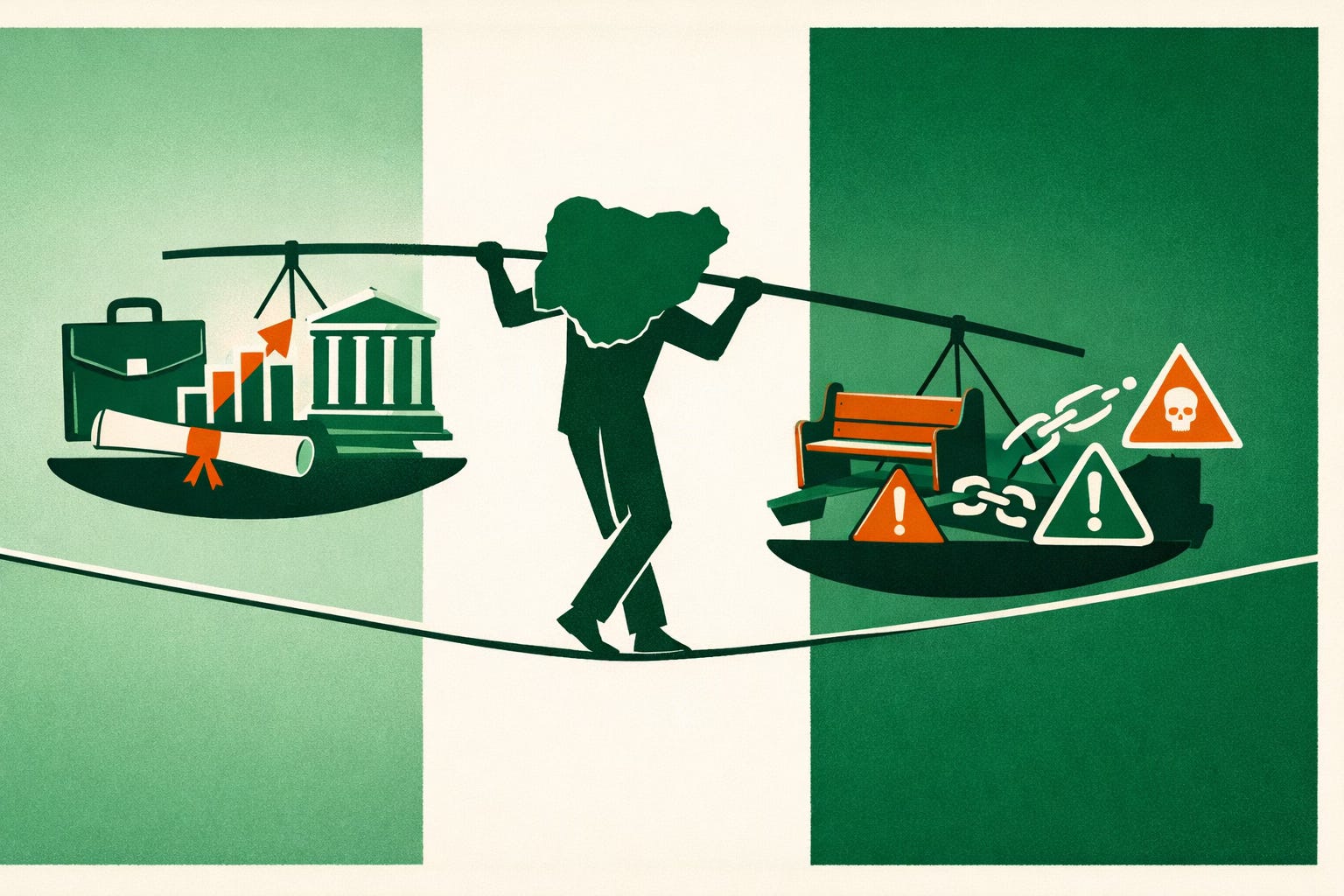
As Vice-President Shettima inaugurated the country’s first World Economic Forum pavilion in Davos, armed gangs abducted 163 church worshippers in Kaduna—a crisis state officials initially denied. Yet beneath the dissonance lie genuine economic gains: inflation fell to 15.15%, its lowest since 2020; banks raced toward recapitalization targets; the stock market surged 44%; and a historic agreement ended sixteen years of deadlock with university lecturers. The central question remains whether reform momentum can overcome chronic institutional weakness—or whether the gap between investor presentations and citizen protection will prove politically unsustainable.
Table of contents
Politics and governance
Defections signal APC’s tightening grip
Rivers State’s byzantine power struggle
Senate receives 68 ambassadorial nominees
Economy and business
Inflation’s descent anchors optimism
The stock market’s remarkable run
Banks race toward recapitalization
Naira stability provides breathing room
Security and defence
Kaduna church kidnapping tests government credibility
Northeast operations intensify
Kogi claims 200 bandits killed
U.S. cooperation deepens despite tensions
Society and culture
University agreement ends sixteen years of deadlock
Super Eagles claim bronze with style
FCT workers strike over broken promises
Technology, infrastructure, and innovation
Paystack’s banking ambitions
SEC doubles crypto capital requirements
Lagos-Calabar highway reaches 70% completion
Power sector’s stubborn arithmetic
International relations
Nigeria House debuts at Davos
U.S. relations stabilize after airstrikes
ECOWAS leadership tested and validated
The week ahead
Politics and governance
Defections signal APC’s tightening grip
The ruling All Progressives Congress continued its consolidation campaign with a symbolically potent acquisition: Abubakar Atiku Abubakar, son of former Vice-President Atiku Abubakar—the man who lost three presidential bids to the APC—defected on January 15 at the National Assembly in Abuja. The younger Atiku directed his Haske Organisation’s networks across the Northeast to support President Tinubu’s 2027 re-election, a blow to his father’s remaining presidential ambitions.
The APC now commands 28 of 36 governorships, up from 21 after the 2023 elections. The opposition PDP has hemorrhaged to just four governors. The African Democratic Congress has emerged as the umbrella for a potential Atiku-Peter Obi alliance, with Atiku using social media on January 20 to urge supporters to cease attacking the Labour Party leader—a tacit acknowledgment that opposition unity remains Nigeria’s only viable counterweight.
Rivers State’s byzantine power struggle
The impeachment proceedings against Governor Siminalayi Fubara—now in their third iteration—remained suspended as multiple interventions competed for influence. The Pan Niger Delta Elders Forum dispatched a seven-member committee led by former Attorney-General Kanu Agabi, which shuttled between FCT Minister Nyesom Wike in Abuja and Governor Fubara in Port Harcourt.
The crisis distills a peculiarly Nigerian power dynamic: Wike, the former Rivers governor who delivered his state to Tinubu in 2023, appears determined to demonstrate that governors serve at the pleasure of their political godfathers. A Rivers High Court issued an interim order restraining the Chief Judge from constituting an impeachment panel, buying Fubara time. The Ijaw Youth Council, representing the state’s dominant ethnic group, announced 50,000 voters had transferred registration to Rivers ahead of 2027—a show of demographic force.
Senate receives 68 ambassadorial nominees
President Tinubu submitted a sweeping ambassadorial list on January 16, including former INEC Chairman Mahmood Yakubu, ex-governors Ifeanyi Ugwuanyi and Okezie Ikpeazu, former Chief of Naval Staff Ibok-Ete Ibas, and the divisive Femi Fani-Kayode. The Senate Foreign Affairs Committee has one week to complete screening. Expected postings include China, India, the UAE, and multilateral bodies.
Economy and business
Inflation’s descent anchors optimism
Nigeria’s headline inflation fell to 15.15% in December 2025, down from a peak of 24.48% in January 2025, marking the lowest reading since November 2020. More striking was the monthly food inflation figure: -0.36%, a rare deflation reflecting harvest flows and the Dangote Refinery’s impact on transport costs. The Central Bank projects average inflation of 12.94% for 2026—ambitious, but no longer fantastical.
International institutions have upgraded their forecasts accordingly. The IMF raised its 2026 growth projection to 4.4%, up 0.2 percentage points from October. The World Bank concurred. Finance Minister Wale Edun went further, targeting 4.68% growth—which would mark Nigeria’s fastest expansion in over a decade.
The stock market’s remarkable run
The Nigerian Exchange has become one of the world’s best-performing markets. Total market capitalization reached ₦217.7 trillion ($153 billion) by January 16, a 44.3% gain since December 31, 2025. Equities alone surged 67.2%. Seven banks have crossed the ₦1 trillion market capitalization threshold, reflecting investor confidence in the recapitalization exercise.
Weekly trading volume hit 4.6 billion shares worth ₦130.6 billion—up from 4.2 billion shares the previous week. Financial services dominated, accounting for 68% of turnover volume. The bull run reflects both genuine reform dividends and liquidity seeking refuge from naira volatility.
Banks race toward recapitalization
With the March 31, 2026 deadline looming, 20-22 of 34 banks have met new capital requirements—up from just eight in mid-2025. The thresholds are substantial: ₦500 billion ($350 million) for international licenses, ₦200 billion for national operations. Access, Zenith, GTBank, UBA, First Bank, and Fidelity have cleared the international bar. Fidelity raised ₦259 billion in December alone.
Three major mergers are expected before deadline. Unity Bank and Providus Bank are in final integration stages, set to create a top-10 lender. Nova Bank opted to downgrade to a regional license rather than dilute existing shareholders—a strategic niche play.
Naira stability provides breathing room
The naira traded in a narrow band of ₦1,415-1,433 against the dollar through the week, with the official rate closing around ₦1,420. The parallel market premium narrowed to ₦65-75—modest by historical standards. Foreign reserves stood at $45.4-45.8 billion, with CBN projecting a breach of $50 billion in Q1 2026.
The current account surplus reached $16.94 billion in 2025, with projections of $18.81 billion for 2026. For a country that faced balance-of-payments crisis as recently as 2023, these figures represent a genuine turnaround.
Security and defence
Kaduna church kidnapping tests government credibility
On Sunday, January 19, armed men attacked three churches simultaneously in Kurmin Wali, Kajuru Local Government Area, abducting worshippers during services. The Christian Association of Nigeria confirmed 163 people remained in captivity after nine escaped. Local chief Wali told AFP the figure was 166 from 177 initially taken.
The government’s response was jarring. State Police Commissioner Muhammad Rabiu claimed there was “no information about any attack or kidnapping.” The Internal Security Commissioner dismissed reports as “totally false.” Chief Wali’s response captured citizen frustration: “It is only politicians that are denying the kidnapping of our people.”
The incident occurred in Kajuru district, a known hotspot where ransom-driven kidnapping has become industrialized. SBM Intelligence estimates the kidnapping industry extracted approximately $1.66 million in ransoms between July 2024 and June 2025—likely a significant undercount.
Northeast operations intensify
Nigerian forces repelled coordinated attacks on January 16 in Adamawa and Borno States. At Azir Forward Operating Base, a multi-directional ISWAP assault lasted over an hour, with RPG fire damaging vehicles and surveillance equipment. Nigerian Air Force precision strikes “neutralized additional scores of terrorists” during pursuit operations.
A day earlier, NAF targeted approximately 40 terrorists on ten canoes planning attacks on the Baga axis—a reminder that insurgents retain waterborne mobility across Lake Chad. Intelligence reports indicate ISWAP has acquired roughly 35 new drones transported through Lake Chad, with plans for coordinated aerial attacks on Nigerian positions.
The week’s most significant Northeast development was intra-insurgent violence. ISWAP and Boko Haram factions clashed repeatedly in Sambisa Forest and the Mandara Mountains between January 3-8, with dozens killed and Boko Haram families displaced. Such internecine conflict provides tactical relief but does nothing to address the underlying governance vacuum.
Kogi claims 200 bandits killed
Kogi State announced a major anti-banditry offensive beginning January 11, claiming over 200 bandits killed across dense forest corridors. Helicopter footage showed flames from settlements in forested areas. Security analyst Bashir Galma, a retired army major, cautioned that casualty figures “might well be exaggerated considering there is no proof”—a reminder that body counts often serve political purposes ahead of elections.
U.S. cooperation deepens despite tensions
Army Chief Lt. Gen. Waidi Shaibu met U.S. Defence Attaché Lt. Col. Semira Moore on January 15, seeking enhanced intelligence support, expedited equipment processing, and joint operational planning. The meeting followed National Security Adviser Nuhu Ribadu’s Washington delegation, which refuted genocide allegations while securing commitments for humanitarian assistance and technical support.
The diplomatic dance reflects mutual unease after the December 25 U.S. airstrikes in Sokoto State. Foreign Policy reported experts dispute claims that the strikes killed ISIS-linked Lakurawa fighters—estimated at just 200 members with contested Islamic State connections.
Society and culture
University agreement ends sixteen years of deadlock
The Federal Government and Academic Staff Union of Universities signed a landmark agreement on January 14, concluding negotiations that began in 2009. The deal grants a 40% salary increase through a Consolidated Academic Tools Allowance, with professors receiving an additional ₦140,000 monthly. Research funding will receive at least 1% of GDP through a new National Research Council.
Nigerian students have lost nearly four academic years cumulatively to ASUU strikes since 2009. Education Minister Maruf Alausa called the agreement “a turning point.” Implementation monitoring will determine whether this rhetoric translates into sustained stability.
Super Eagles claim bronze with style
Nigeria defeated Egypt 4-2 on penalties after a goalless draw on January 17 to secure AFCON bronze—the country’s record-extending ninth third-place finish. Goalkeeper Stanley Nwabali saved penalties from Mohamed Salah and Omar Marmoush; Ademola Lookman converted the winner.
Coach Eric Chelle’s squad set a Nigerian AFCON record with 14 tournament goals. Legendary captain Segun Odegbami declared: “These Super Eagles have awakened my once-waning spirit.” The team’s attacking verve provided a unifying national narrative amid the week’s darker developments.
FCT workers strike over broken promises
Thousands of Federal Capital Territory workers began an indefinite strike on January 19 over the government’s failure to implement the FCT Civil Service Commission Act—signed into law in 2018 but never operationalized. Workers cited unpaid promotion arrears, stalled career advancement, and a suspicious 77.5% failure rate in 2024 promotion examinations. Government offices across Abuja were locked down.
Technology, infrastructure, and innovation
Paystack’s banking ambitions
Stripe-owned Paystack acquired Ladder Microfinance Bank in mid-January, enabling expansion from payments into lending. The new Paystack MFB will offer working capital loans, merchant cash advances, and Banking-as-a-Service products—leveraging transaction data from 300,000 Nigerian businesses for credit underwriting. The acquisition intensifies competition with Moniepoint, OPay, and PalmPay.
Days earlier, Flutterwave completed its acquisition of open banking startup Mono for $25-40 million in stock, deepening its data infrastructure. Nigeria’s fintech landscape is consolidating around vertically integrated players with the capital to navigate tightening regulation.
SEC doubles crypto capital requirements
The Securities and Exchange Commission issued Circular 26-1 on January 16, raising minimum capital for digital asset exchanges to ₦2 billion ($1.4 million)—quadruple the previous requirement. Robo-advisers must now hold ₦100 million (up from ₦10 million). The June 2027 compliance deadline favors well-funded incumbents; only Busha and Quidax currently hold provisional licenses.
Lagos-Calabar highway reaches 70% completion
Works Minister Dave Umahi confirmed that Section 1 of the Lagos-Calabar Coastal Highway—a 47.47km stretch—has reached over 70% completion, with full commissioning targeted for April 2026. The $747 million loan from Deutsche Bank finances this section; total project cost may reach $11-12.5 billion across the 700km route connecting nine coastal states. The road will be tolled by contractor Hitech Construction upon inauguration.
Power sector’s stubborn arithmetic
Nigeria generated 4,826 MW at peak on January 16-17—against installed capacity of 13,000 MW. The World Bank estimates annual economic losses of $29 billion (2% of GDP) from unreliable power. Fewer than 55% of customers are metered. A $750 million World Bank campaign is driving diesel-to-solar transition in rural communities, with 7.8 million Nigerians newly electrified—but grid-scale transformation remains elusive.
International relations
Nigeria House debuts at Davos
Vice-President Shettima inaugurated Nigeria House on January 19—the country’s first sovereign pavilion at the World Economic Forum. The public-private partnership showcased four investment playbooks covering solid minerals, climate-sustainable agriculture, creative industries, and digital economy. “Nigeria is open for business, and more importantly, open for collaboration,” Shettima declared.
The delegation presented compelling numbers: GDP growth approaching 4% in 2025, non-oil sectors comprising 96% of output, inflation halved from 2024 peaks, reserves above $45 billion. Foreign portfolio and direct investment reached nearly $14 billion in the first nine months of 2025, with Q3 FDI surging 700% quarter-on-quarter to $720 million.
U.S. relations stabilize after airstrikes
The Christmas Day U.S. strikes on Sokoto State cast a shadow over bilateral relations. Nigeria’s delegation to Washington—led by NSA Ribadu with the Attorney-General, Defence Chief, and Police Inspector-General—refuted religious persecution claims while securing commitments for enhanced intelligence support and expedited defense equipment processing.
A five-year, $5.1 billion health cooperation agreement signed in January demonstrates the relationship’s depth: $2.1 billion in U.S. grants, $3 billion in Nigerian domestic resource mobilization, covering HIV, TB, malaria, and maternal health through 2030.
ECOWAS leadership tested and validated
Nigeria’s deployment of Air Force jets and troops alongside Sierra Leonean, Ivorian, and Ghanaian forces helped thwart Benin’s late-2025 coup attempt—what the International Crisis Group called “the bloc’s firmest and most successful stance against an unconstitutional power grab since 2017.” The National Assembly approved the deployment at Benin’s request.
ECOWAS approved $2.85 million from the Regional Security Fund for each of five frontline states including Nigeria. Yet the bloc remains weakened by the January 2025 departure of Burkina Faso, Mali, and Niger to form the Alliance of Sahel States.
The week ahead
The World Economic Forum continues through January 23, with Vice-President Shettima’s remaining bilateral meetings potentially yielding immediate FDI announcements or partnership agreements. The finance minister’s sessions on sovereign debt restructuring and the solid minerals sector will be closely watched.
The January 22 resumption of the National Assembly could bring movement on pending legislation, including the controversial tax reform bills that stalled in December. Senate screening of the 68 ambassadorial nominees is expected to begin immediately, with confirmation votes possible before the week ends.
Markets will monitor whether the naira’s stability holds through month-end dollar demand, particularly from manufacturers and importers settling Q4 obligations. Any CBN intervention or guidance on forex policy would be significant.
The Kaduna kidnapping crisis should produce developments within days—either ransom negotiations, rescue operations, or tragically, proof-of-life demands. How the federal government responds after state officials’ denials will test crisis management credibility.
Key wildcards include potential Rivers State High Court rulings on the impeachment proceedings, any ASUU statements on implementation timelines for the January 14 agreement, and whether the FCT workers’ strike expands or resolves quickly. Oil production figures for early January, when released, will indicate whether the 1.54 million bpd combined output from December—which included 1.42 million bpd of crude and 122,000 bpd of condensates—can begin to climb toward the ambitious 1.84 million bpd benchmark set in the 2026 budget.