

Twenty-four schoolgirls are rescued—but 303 students vanish in Nigeria’s latest mass school abduction. The Central Bank holds rates steady despite seven months of disinflation, IPOB’s leader receives a life sentence, and the ruling party swallows another state whole.
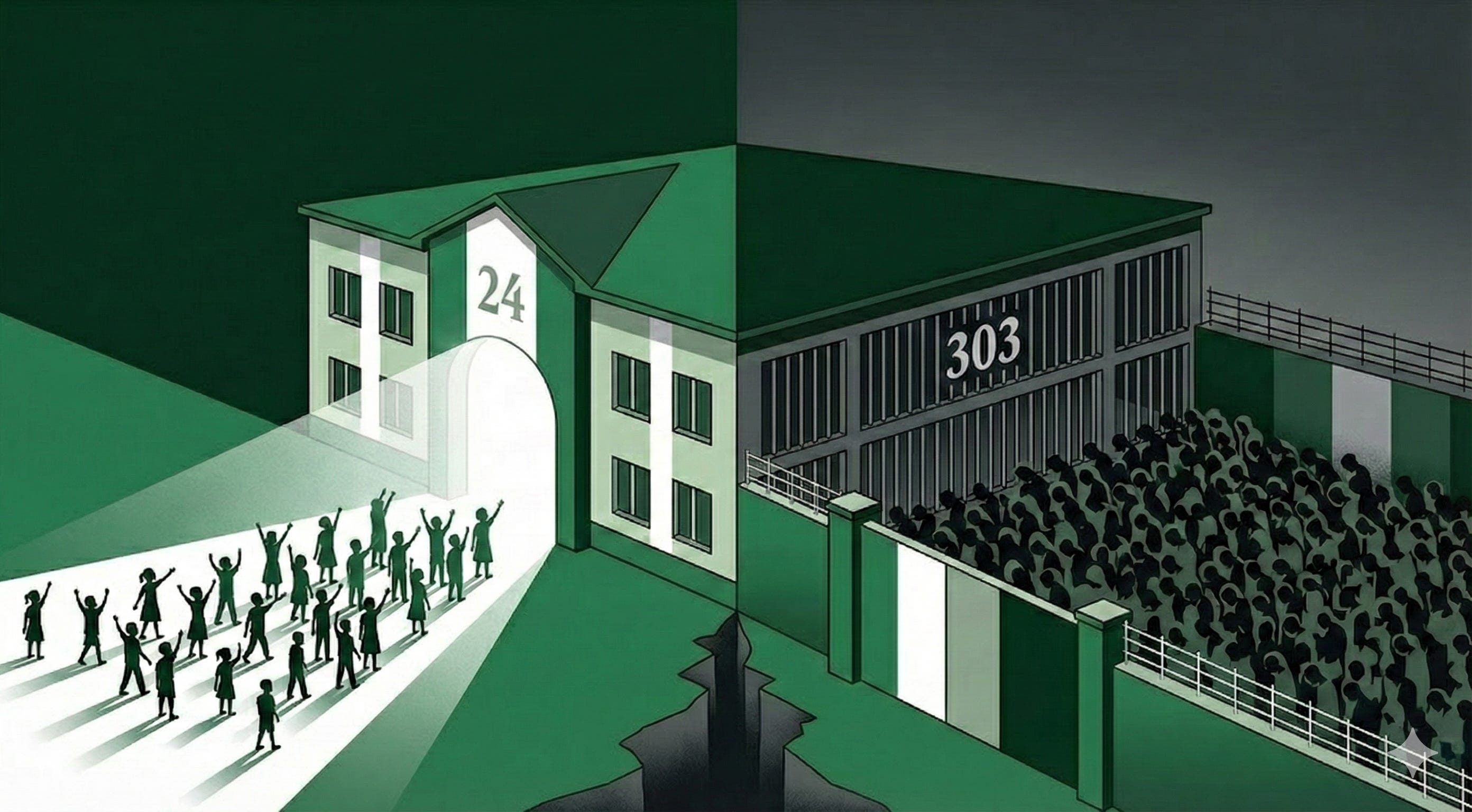
Nigeria has grown practiced at managing multiple crises simultaneously—a necessary skill when governing 237 million people across terrain ranging from Sahelian banditry to Delta oil theft. Yet even by Nigerian standards, the week of November 19-25 was remarkable: 303 students kidnapped on Thursday, 24 schoolgirls freed on Monday (from an earlier abduction). President Bola Tinubu cancelled his G20 appearance, the Central Bank held interest rates steady despite seven consecutive months of disinflation, and IPOB leader Nnamdi Kanu received a life sentence that his supporters vow to appeal. That security collapses while the economy stabilizes captures Nigeria’s essential paradox: a snapshot of Africa’s most populous nation at an inflection point, with neither optimism nor despair entirely justified.
Politics & Governance
Life imprisonment for Kanu—death penalty withheld, appeals promised
The defining political act of the week occurred not in Abuja’s legislative chambers but in a courtroom. On November 20, Justice James Omotosho of the Federal High Court convicted Nnamdi Kanu, leader of the Indigenous People of Biafra, on all seven terrorism counts, sentencing him to life imprisonment on four counts, twenty years on another, and five on the remainder—all to run concurrently. The judge stopped short of imposing the death penalty, citing judicial mercy, though Kanu’s dramatic ejection from court before sentencing for “unruly conduct” suggested the defendant saw little mercy in the proceedings. His lawyers immediately announced plans to appeal, arguing that the charges rested upon a since-repealed terrorism statute. Abia State Governor Alex Otti, threading a needle familiar to southeastern politicians, announced he would pursue an “alternative resolution strategy” through diplomatic channels—a tacit acknowledgment that the courtroom avenue appears closed.
The conviction removes a persistent symbolic thorn from Tinubu’s side, yet its political ramifications remain uncertain. IPOB’s “sit-at-home” orders have paralyzed economic activity across the Southeast for years, and the movement’s capacity for disruption will now be tested without its charismatic figurehead. The government will hope the verdict breaks the spell; skeptics note that martyrdom has historically strengthened, not weakened, secessionist movements.
Twenty-five states and counting: the relentless APC tide
Meanwhile, the All Progressives Congress continues its inexorable consolidation of power. In Taraba State, all 24 members of the State House of Assembly, including the Speaker, have defected to the ruling party, along with the Secretary to the State Government and the PDP state chairman himself. Governor Agbu Kefas has “unofficially” aligned with the APC; his formal reception, scheduled for November 19, was postponed only because the Kebbi school kidnapping demanded national mourning. The wave of defections means the APC now controls 25 of 36 governorships, with projections suggesting the figure could exceed 30 by the 2027 elections.
The PDP’s death spiral continues, this time with teargas
The opposition People’s Democratic Party, by contrast, appears locked in terminal crisis. Its November 15-16 convention in Ibadan—held despite conflicting court orders—expelled ten members including FCT Minister Nyesom Wike and former Ekiti Governor Ayodele Fayose. Violence erupted at the party’s Wadata Plaza headquarters on November 18, when rival factions clashed and police deployed teargas. By week’s end, the Wike faction had filed suit seeking nullification of the entire convention. The internecine warfare has paralyzed the party’s capacity to mount coherent opposition, leaving Nigeria drifting toward what Senator Seriake Dickson has warned is “a one-party state.”
Meanwhile, constitutional reform
The National Assembly, seemingly oblivious to the tumult, pressed forward with constitutional amendments. At a November 24 retreat, Deputy Senate President Barau Jibrin and Deputy Speaker Benjamin Kalu declared the deliberation phase closed, targeting transmission of amendment bills to state assemblies before year-end. Proposals under consideration include devolution of powers, local government autonomy, state policing, and enhanced fiscal federalism—reforms that, if enacted, would represent the most significant constitutional changes since 1999.
Economy & Business
The Central Bank surprises markets: 27% holds despite seven months of disinflation
The headline economic news emerged on November 25, when the Central Bank of Nigeria concluded its 303rd Monetary Policy Committee meeting by retaining the benchmark interest rate at 27%—surprising markets that had anticipated the first cut in over a year. Governor Olayemi Cardoso justified the hold as prudent watchfulness, noting the need for “clearer assessment of near-term economic conditions” despite encouraging data.
That data is unambiguously positive. October inflation fell to 16.05%, down from 18.02% in September and marking the seventh consecutive month of disinflation. The figure represents the lowest headline rate since March 2022, a remarkable turnaround from the 34.6% peak recorded exactly one year ago. Food inflation dropped even more sharply, to 13.12% from 16.87%, benefiting from the harvest season and targeted market interventions. Core inflation touched 18.7%, its lowest since February 2023.
Yet the central bank’s caution reflects legitimate concerns. Holding rates at 27% imposes punishing borrowing costs on businesses and consumers, constraining credit growth and investment. The MPC appears to believe that inflation’s decline owes more to base effects and harvest seasonality than durable structural change, and that premature easing could reignite price pressures. Whether this judgment is correct will be tested in coming months.
Foreign reserves hit seven-year high as Eurobond breaks records
The naira, which has been the administration’s albatross since Tinubu’s controversial float in June 2023, traded in a relatively stable band around ₦1,450-1,456 to the dollar in official markets, with the parallel market spread narrowing to below 2%. Foreign reserves have climbed to $46.7 billion—a seven-year high—providing 10.3 months of import cover. The accretion reflects renewed investor confidence, improved oil receipts, and the successful issuance of a $2.35 billion Eurobond in early November that attracted $13 billion in orders, the largest orderbook in Nigerian sovereign debt history.
Dangote’s refinery ambitions double while telecoms profits surge
The real economy showed corresponding signs of life. Dangote Refinery announced a partnership with Honeywell International to expand capacity from the current 650,000 barrels per day to 1.4 million bpd by 2028, which would make it the world’s largest petroleum refining complex. The refinery distributed 438 million litres of petrol in the first half of November and reduced its gantry price to ₦828 per litre, a 5.6% decrease that is gradually filtering through to consumers.
In telecommunications, MTN Nigeria reported a dramatic turnaround, posting ₦750.2 billion profit after tax for the first nine months of 2025—a 245.7% swing from a ₦514.9 billion loss in the same period last year. The sector’s resilience underscores the structural strength of Nigeria’s consumer economy even amid macroeconomic turbulence. The Nigerian Stock Exchange’s All-Share Index ended the week at 143,763 points, up 0.10% after the MPC decision, though banking stocks have suffered a 7% weekly decline amid year-end profit-taking.
Security & Defense
The Kebbi rescue: success without ransom, if the government is to be believed
The week’s security narrative contains both triumph and tragedy, though tragedy predominates. On November 25, President Tinubu announced that all 24 schoolgirls kidnapped from Government Girls Comprehensive Secondary School in Maga, Kebbi State on November 17 had been rescued. Governor Nasir Idris confirmed that no ransom was paid by either state or federal government—a claim that would be more credible were it not for the long Nigerian tradition of paying ransoms while insisting ransoms were not paid.
Niger State’s 303: Nigeria’s largest school kidnapping yet
Whatever relief the rescue provided was tempered by a far larger crisis that had erupted four days earlier. On November 21, armed bandits attacked St. Mary’s Catholic Primary and Secondary School in Papiri, Niger State, abducting 303 students and 12 teachers in one of the largest school kidnappings in Nigerian history. The three-hour assault saw children aged 10-18 herded onto a truck under cover of darkness. By week’s end, 50 students had escaped and reunited with families, but 253 students and 12 teachers remained in captivity, their fate unknown. Pope Leo XIV appealed for their release during Sunday’s Angelus prayer; the Nigerian government closed 47 federal schools and Niger State shuttered all educational institutions until 2026.
Peace deals with bandit kingpins collapse across four states
The attacks underscore the collapse of peace deals that state governments had brokered with bandit kingpins in Zamfara, Kaduna, Katsina, and Sokoto. Notorious commanders including Dogo Gide and Yellow Janbros have reportedly lost control of subordinates who continue killing and kidnapping despite ceasefire commitments. The government’s response—ordering 24-hour aerial surveillance over forests in Kwara, Niger, and Kebbi states—represents familiar kinetic thinking, though the forests’ vast expanses have consistently frustrated military operations.
A brigadier general’s execution exposes intelligence and coordination failures
Also weighing heavily on military morale is the execution of Brigadier General Musa Uba by Islamic State West Africa Province following an ambush near Wajirko, Borno State on November 14. The brigade commander, one of the highest-ranking officers fighting insurgents in the Lake Chad region, sent desperate WhatsApp messages to colleagues after capture—“My battery is 31% now... once I see the aircraft, I can raise my peak cap”—before ISWAP switched off his phone and executed him. His death raises troubling questions about intelligence leaks and military coordination.
ISWAP suffers territorial losses—not to Nigeria but to rival jihadists
In a grim irony, ISWAP itself suffered significant losses during the week—not from Nigerian forces but from rival Boko Haram factions. Fighting over Lake Chad islands, which control lucrative smuggling corridors, saw JAS fighters kill over 50 ISWAP combatants and seize seven boats in what analysts describe as ISWAP’s biggest territorial loss since Abubakar Shekau’s death in 2021. The inter-jihadist warfare may weaken both groups, but history suggests it will also generate displaced fighters seeking softer targets.
Society & Culture
Universities spared shutdown as ASUU accepts another round of negotiations
The Academic Staff Union of Universities had threatened to shut down all public institutions from November 21, but the feared indefinite strike did not materialize. Emergency negotiations through the Yayale Ahmed Renegotiation Committee on November 24-25 appear to have secured a reprieve, with ASUU announcing its National Executive Council would convene on November 26 to review outcomes. The union had rejected the government’s 35% salary increase offer, demanding full implementation of a 2009 agreement that successive administrations have honored mainly in the breach. Education Minister Tunji Alausa insists the government has met ASUU’s requirements; the union disagrees. The brinkmanship will likely continue, as it has for decades.
National unity festival cancelled as national tragedy takes precedence
The planned National Festival of Arts and Culture (NAFEST) in Enugu, scheduled for November 22-29, was postponed indefinitely following the school kidnappings. Some 28 states had already arrived in Enugu when Culture Minister Hannatu Musa Musawa announced the cancellation, citing the need for national mourning. The festival would have featured the first Northern Durbar ever held in the Southeast, with over 50 horses transported from Katsina—a symbolically potent gesture of national unity now deferred to an uncertain future.
Dengue emerges in Sokoto as Lassa fever’s fatality rate exceeds last year’s
On the health front, Sokoto State confirmed 8 laboratory-verified cases of dengue fever in Sokoto North and Sokoto South local government areas, prompting health officials to alert facilities across the state. Meanwhile, the Nigeria Centre for Disease Control’s Week 44 report documented a Lassa fever case fatality rate of 18.3%, higher than the 16.5% recorded in the same period last year, with 177 deaths from 966 confirmed cases across 21 states.
Nigeria eliminated 4-3 on penalties; squad overhaul promised for AFCON
Nigerian sports offered only additional disappointment. The Super Eagles’s 1-1 draw with DR Congo on November 16, followed by a 4-3 penalty shootout defeat, eliminated Nigeria from World Cup qualification for the second consecutive tournament. The Nigeria Football Federation apologized to President Tinubu and promised a “major squad overhaul” ahead of the Africa Cup of Nations, which begins December 21 in Morocco.
International Relations
Nigeria champions mineral equity and UN reform at back-to-back summits
President Tinubu’s cancellation of his G20 appearance in Johannesburg to address the Kebbi kidnapping crisis left Vice President Kashim Shettima to articulate Nigeria’s positions at the summit on November 22-23. Shettima’s interventions focused on critical minerals governance, demanding a “global framework that promotes value addition at source” and ensures host communities benefit from extraction—a pointed message to Western powers seeking African resources for energy transitions. Nigeria also backed global AI ethics standards and called for reform of international financial architecture to address developing-country debt burdens.
At the 7th AU-EU Summit in Luanda on November 24-25, Shettima intensified Nigeria’s push for permanent African seats with veto power on the UN Security Council, calling reform “long overdue.” In a notable policy declaration, he rejected the presence of private military companies on African soil, stating that “only African-led solutions free from private military firms will guarantee lasting peace”—an unmistakable rebuke of Wagner Group operations elsewhere on the continent. Shettima also revealed that over 250,000 Boko Haram-affiliated individuals have surrendered since Tinubu took office, though the figure is difficult to verify.
Trump’s “guns-a-blazing” threat recedes into diplomatic engagement
The shadow over Nigerian diplomacy remains Washington. President Trump’s November 1 threat to “go into that now disgraced country, guns-a-blazing” over alleged Christian persecution has created unprecedented tensions. The Nigerian government rejected the “Christian genocide” characterization as inconsistent with evidence that victims include Muslims and Christians alike. National Security Adviser Nuhu Ribadu led a delegation to Washington, meeting with Defense Secretary Pete Hegseth and other officials. The State Department subsequently signaled a “broader approach” encompassing diplomatic tools, sanctions, and intelligence-sharing—suggesting the military rhetoric was posturing rather than policy.
China commits $20 billion
China offers a counterweight. NCSP Director Joseph Tegbe announced $20 billion in Chinese investment commitments targeting agriculture, automotive manufacturing, steel, and energy. Bilateral trade surpassed $20 billion annually, with China now among Nigeria’s largest trading partners.
The Week Ahead
Tactical squads and local hunters search forests for 265 missing
The immediate priority remains the 253 students and 12 teachers still held captive following the Niger State school attack. Security forces have established cordons over forests in Kwara, Niger, and Kebbi states, with tactical squads and local hunters deployed. The coming days will reveal whether kinetic operations can succeed where they have so often failed.
Constitutional votes expected before year-end; tax reform remains stalled
The National Assembly will brief state governors on constitutional amendment proposals on November 26, with legislative voting expected before year-end. Tax reform bills, controversial among state governors who fear losing revenue allocation, remain in procedural limbo despite Senate passage.
Detty December arrives with billions—and the shadow of captive children
December brings “Detty December”—the annual influx of diaspora Nigerians and festival season that pumps billions into the economy. Whether the month’s celebrations will be shadowed by ongoing security crises depends largely on developments in the next few days. Nigeria has grown accustomed to holding joy and grief simultaneously; the week ahead will test whether that capacity has limits.
The Federal Republic is a weekly newsletter analyzing Nigerian politics, economics, security, and society. Subscribe for comprehensive briefings every Wednesday.
They are all on points and facts about Nigeria 🇳🇬