

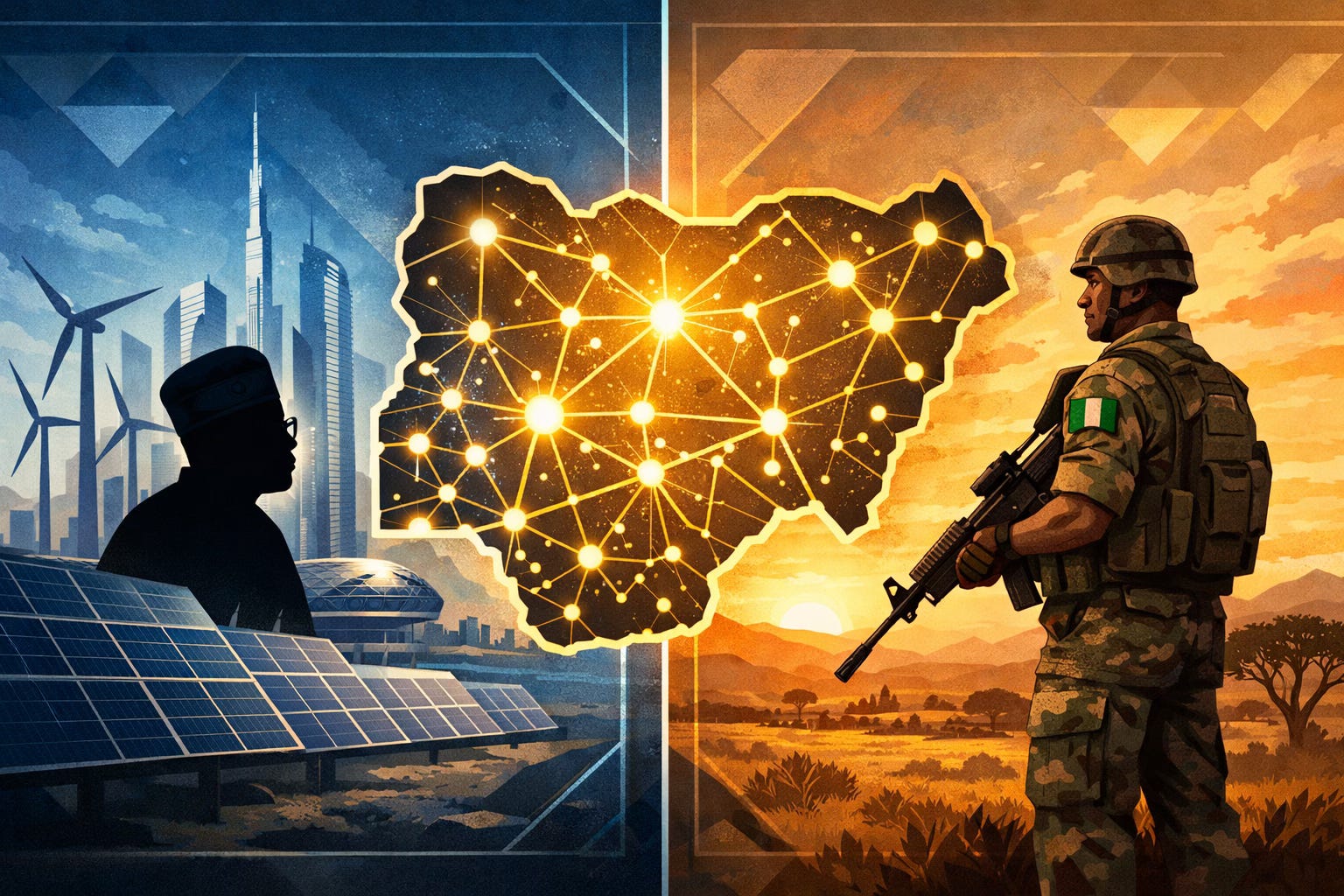
Nigeria bet big on itself this week—and the wager is showing early promise. As the stock market breached ₦100 trillion for the first time and inflation touched five-year lows, President Bola Tinubu flew to Abu Dhabi to court climate investors while his party consolidated control over 24 of 36 states. The Super Eagles thrashed Algeria 2-0 to reach the Africa Cup semi-finals, offering 220 million Nigerians a rare moment of unified joy. Yet beneath the champagne corks and market rallies, familiar shadows lingered: bandits killed 14 in Taraba State, the power grid delivered barely 3,800 megawatts, and Rivers State lawmakers launched yet another impeachment against their governor.
Table of Contents
Politics & Governance
The South-East falls into line
Rivers State’s serial impeachment
Carbon and AI
Economy & Business
The ₦100 trillion milestone and what it means
The naira’s curious stability
Banks race to recapitalise
Security & Defence
Bandits, borders, and American assistance
Farmer-herder violence claims 14 lives
Society & Culture
Super Eagles soar, bonuses or not
AFRIMA celebrates Nigerian dominance
Nollywood’s billion-naira milestone
Technology, Infrastructure & Innovation
Nigeria’s first defense-tech champion
Power grid struggles continue
International Relations
Abu Dhabi and Davos frame Nigeria’s pitch
US-Nigeria security partnership deepens
Turkey courts Nigerian business
The Week Ahead
AFCON semi-final: Morocco awaits
WEF Davos: Nigeria House opens
Healthcare strike ruling
Economic data watch
Politics & Governance
The South-East falls into line
The most consequential political development of the week occurred on January 12 in Enugu, where the South-East’s APC leadership—led by Governors Hope Uzodimma (Imo) and Francis Nwifuru (Ebonyi), alongside the strategically aligned Peter Mbah (Enugu)—formally endorsed President Tinubu as the party’s sole candidate for 2027. The endorsement, delivered at a meeting of the “Izu Umunna” stakeholders’ forum, came a full 20 months before the next presidential ballot. “Politics is pay as you earn,” declared Governor Uzodimma with characteristic bluntness.
The early commitment reflects shrewd political calculation. The South-East contributed just 6% of APC’s votes in 2023, compared with 34-54% from other geopolitical zones. But the region’s political landscape has transformed dramatically: the APC now controls three of five South-East states, up from none before 2023, and its Senate seats in the zone have grown from six to eight. Former Senate Presidents Pius Anyim and Ken Nnamani attended the Enugu gathering—a signal that the Igbo political establishment is pivoting toward the ruling party. Whether this represents pragmatic accommodation or democratic erosion depends on one’s vantage point.
Rivers State’s serial impeachment
The darker side of APC consolidation emerged in Port Harcourt where Speaker Martins Amaewhule announced on January 8 that 26 of 32 lawmakers had signed an impeachment notice against Governor Siminalayi Fubara. The charges—refusing to present a 2026 appropriation bill and spending without legislative approval—echo complaints lodged in previous attempts. “Rivers has never had it this bad,” declared Amaewhule, though critics noted the crisis stems from Fubara’s feud with his predecessor Nyesom Wike, now the powerful FCT Minister and key Tinubu ally.
This marks the third major legislative attempt to oust Fubara since his 2023 inauguration. Two assembly members—Minority Leader Sylvanus Nwankwo and Hon. Peter Abbey—broke ranks on January 12 to plead for dialogue, but the proceedings continue. The Rivers saga illustrates how Nigeria’s governing party enforces discipline: governors who resist absorption face relentless institutional pressure.
Carbon and AI
President Tinubu spent January 11-13 in Abu Dhabi for the 2026 Sustainability Week, where he approved the Carbon Market Framework that officials say could attract $3.8 billion annually in climate investments. The National Council on Climate Change has already received 3,000-4,000 project applications since October 2025. Whether Nigeria’s notoriously weak regulatory institutions can manage this influx remains an open question.
Nigeria is poised to pass the National Digital Economy and E-Governance Bill, potentially making it among the first African nations to regulate artificial intelligence. The legislation would grant regulators new powers over algorithms and digital platforms—a significant step for a country whose tech ecosystem has grown faster than its governance frameworks.
Economy & Business
The ₦100 trillion milestone and what it means
When the Nigerian Exchange’s market capitalisation crossed ₦100 trillion on January 5, 2026, President Tinubu hailed the “birth of a new economic reality.” The All-Share Index delivered a 51.19% return in 2025, following 37.65% in 2024—making Nigerian equities among the world’s best performers for two consecutive years. As of January 9, the market had registered 19 consecutive bullish sessions.
The rally reflects genuine macroeconomic improvement, though the data requires nuance. Headline inflation decelerated to 14.45% in November 2025—the lowest since October 2020. However, this dramatic drop from 34.8% in late 2024 was largely driven by a rebasing of the Consumer Price Index (CPI) rather than pure price moderation. Foreign reserves reached $45.62 billion by January 6, while foreign direct investment surged to $720 million in Q3 2025, an eightfold increase from the previous quarter. Non-oil exports also grew 48% to ₦9.2 trillion.
Yet caution is warranted. The National Bureau of Statistics warned on January 12 that December 2025 inflation figures—due January 15—will show an “artificially spiked” rate of 31.2% due to base effect adjustments following the rebasing. The bureau plans to publish dual readings for transparency to help markets distinguish between genuine economic recovery and statistical artifacts.
The naira’s curious stability
The naira traded between ₦1,415-1,441 to the dollar in the official market during the week, with the parallel market spread narrowing to around ₦70-80—a significant improvement from the ₦200+ gaps of 2024. On January 7, the naira hit ₦1,418.26, representing an 8.2% year-on-year appreciation. PwC projects the currency will stabilize in the ₦1,440-1,500 range for 2026, while optimistic analysts at CardinalStone suggest it could strengthen to ₦1,350-1,450. The Central Bank maintained its policy rate at 27% following November’s Monetary Policy Committee meeting, but analysts expect 300-400 basis points of cuts during 2026 as inflation moderates.
In a significant shift, new cash handling rules effective January 1, 2026 increased withdrawal limits to better reflect current economic realities and inflation. Weekly limits now allow for ₦500,000 for individuals (up from ₦100,000) and ₦5 million for corporates (up from ₦500,000). The ATM daily limit is set at ₦100,000, with these higher caps intended to provide relief to depositors while maintaining the push toward a digital financial system.
Banks race to recapitalise
With the March 31, 2026 deadline for bank recapitalisation approaching, 22 of 34 banks have now met the new capital requirements, up from just eight in mid-2025. International banks must reach ₦500 billion in capital and national banks ₦200 billion. The Unity Bank and Providus Bank merger is in its final stages, supported by a ₦700 billion CBN lifeline to facilitate the transition into the new Providus-Unity Bank (PUB). Analysts at DataPro expect at least three more mergers before the deadline. The consolidation is reshaping Nigeria’s financial sector—and creating opportunities for stronger players to absorb weaker competitors.
Security & Defence
Bandits, borders, and American assistance
The security situation in northwest Nigeria remains grim but showed flickers of coordination. On January 10-11, the Nigerian Army’s 8th Division conducted a tactical ambush in the Sabon Birni corridor, neutralizing 11 bandits and preventing a planned strike on Tara village. This followed a period of increased cross-border intelligence sharing with Nigerien forces. The following day, police in Kaduna foiled a planned attack on Idisu village by a group led by notorious kingpin Kachalla Sanusi Bajira, killing two bandits and recovering AK-47 rifles.
On January 12, troops in Borno State eliminated eight terrorists during clearance operations, while military forces rescued 18 passengers from a hijacked boat on Nigeria-Cameroon coastal waterways. The Army’s 2025 statistics, released during the week, recorded 4,375 terrorist arrests, 2,336 civilian rescues, and 503 illegal refinery destructions.
The most significant development came on January 13, when US Africa Command announced the delivery of “critical military supplies” to Nigeria—a visible sign of strengthening security cooperation following the controversial December 25 joint US-Nigerian strikes against Islamic State militants in Sokoto. The Pentagon operation killed key Lakurawa commanders but also sparked debate about sovereignty and religious targeting. Remnants of the group are reportedly fleeing toward Niger and Chad.
Farmer-herder violence claims 14 lives
The week’s deadliest incident occurred in Taraba State on January 9, when suspected Fulani herders killed 14 people in coordinated attacks on Tor-Damsa in Donga local government area. Victims included the village head of Anchough-Shagu and a local councilor. The killings apparently followed a dispute over a destroyed cassava farm. The Nigeria Security and Civil Defence Corps disclosed that Oyo State alone records approximately 100 farmer-herder clashes monthly, concentrated in the Oluyole, Oke-Ogun, and Ibarapa areas.
Society & Culture
Super Eagles soar, bonuses or not
Nigeria’s 2-0 quarter-final demolition of Algeria on January 10 in Marrakesh was the week’s most unifying moment. Victor Osimhen—now with 35 international goals and closing on Rashidi Yekini’s all-time record of 37—opened scoring in the 47th minute; debutant Akor Adams added the second ten minutes later. The Super Eagles have scored 14 goals in five tournament matches, the competition’s most prolific attack.
The victory came despite drama: players had threatened to boycott the match over unpaid bonuses from earlier rounds. The Nigeria Football Federation reported the Central Bank was “processing” the payments. Post-match, CAF opened an investigation into an altercation between players and officials from both teams. The semi-final against host nation Morocco on January 14 promises even higher stakes—and BUA Group Chairman Abdul Samad Rabiu has offered $500,000 if Nigeria prevails.
AFRIMA celebrates Nigerian dominance
The 9th All Africa Music Awards on January 11 at Lagos’s Eko Convention Centre showcased Nigeria’s cultural soft power. Rema claimed Artist of the Year among his three awards; Burna Boy won Album of the Year for “No Sign of Weakness”; and Shallipopi took Song of the Year for “Laho.” Nigerian artists dominated the ceremony, which was broadcast across 84 countries in partnership with the African Union Commission.
Nollywood’s billion-naira milestone
Funke Akindele’s “Behind the Scenes” became the first Nollywood film to gross ₦2 billion in cinema sales, reaching the milestone on January 13—barely a month after its December 12 release. FilmOne declared Akindele “Africa’s most commercially successful filmmaker” and the first to rank number one at the African box office for three consecutive years. The achievement underscores Nollywood’s growing commercial sophistication—and its potential as an export industry.
Technology, Infrastructure & Innovation
Nigeria’s first defense-tech champion
The week’s most intriguing startup story emerged on January 12: Terra Industries, founded by 22-year-old Nigerian entrepreneur Nathan Nwachuku, raised $11.75 million in seed funding led by 8VC—the firm of Palantir co-founder Joe Lonsdale. The Abuja-based company builds autonomous defense systems including long-range surveillance drones and ground robotics, with a team including former Nigerian military engineers. The goal: create Africa’s first homegrown “defense prime” rather than relying on foreign contractors. In a country plagued by insecurity, indigenous defense manufacturing may be as valuable as any fintech unicorn.
Power grid struggles continue
Despite budget allocations of ₦1.096 trillion for electricity capital projects in 2026, the grid delivered just 3,810 megawatts on January 11—a sharp 12% decline from the 4,330 MW recorded on January 5. A December 29 grid collapse continues to affect recovery. The Rural Electrification Agency received the largest share of power-sector funding at ₦502.21 billion, reflecting the government’s emphasis on off-grid solutions.
International Relations
Abu Dhabi and Davos frame Nigeria’s pitch
President Tinubu’s Abu Dhabi visit positioned Nigeria as serious about climate finance and sustainable development. The approved Carbon Market Framework signals intent to capture global green investment flows—though implementation will test Nigeria’s institutional capacity. Before arriving in the UAE, Tinubu held discussions with Presidents Paul Kagame of Rwanda and Emmanuel Macron of France.
Looking ahead, the Federal Government has established Nigeria House Davos for the first time at the World Economic Forum (January 19-23). The public-private initiative will showcase five thematic areas: solid minerals, agriculture, climate investment, digital trade, and the creative economy. It represents Nigeria’s most ambitious Davos presence yet—a clear signal that attracting foreign investment remains the administration’s paramount objective.
US-Nigeria security partnership deepens
The January 13 US military supply delivery formalized what the December 25 strikes made obvious: Washington sees Nigeria as a critical counter-terrorism partner. The relationship has navigated tensions—the US designated Nigeria a “Country of Particular Concern” for religious freedom in 2025, and new visa restrictions took effect January 1. But a $5.1 billion bilateral health cooperation MoU ($2.1 billion from the US, $3 billion from Nigeria) suggests the partnership has strategic depth beyond security.
Turkey courts Nigerian business
Interior Minister Olubunmi Tunji-Ojo met Turkish Ambassador Mehmet Poroy on January 13 to discuss visa facilitation and business mobility. Turkey requested inclusion in Nigeria’s e-visa system and highlighted its 12 weekly flights to Nigeria. The engagement reflects Nigeria’s diversifying diplomatic portfolio—and Turkish interest in Africa’s largest market.
The Week Ahead
AFCON semi-final: Morocco awaits
The Super Eagles face host nation Morocco at Rabat’s Prince Moulay Abdellah Stadium on Wednesday, January 14 at 9:00 PM West African Time. Morocco—reaching their first AFCON semi-final in 22 years—will have approximately 70,000 home supporters. Captain Wilfred Ndidi is suspended. A victory would send Nigeria to Sunday’s final against Senegal or Egypt; defeat means a third-place playoff on January 17.
WEF Davos: Nigeria House opens
January 19-23 will see Nigeria’s first official presence on the Davos Promenade. High-level roundtables targeting foreign investors are scheduled across all five days, with thematic programming on minerals, agriculture, climate, digital trade, and creative industries.
Healthcare strike ruling
The National Industrial Court will rule on January 21 regarding resident doctors’ suspended strike action. An interim order currently bars industrial action, but disputes over professional allowances and salary arrears remain unresolved. A ruling favoring the doctors could disrupt public hospital services nationwide.
Economic data watch
December 2025 inflation figures are due January 15, with the NBS flagging an expected methodological jump to 31.2%—alongside clarifying dual-track data for transparency. Markets will parse whether this reflects genuine price pressures or statistical noise.
The week of January 7-13 offered a concentrated portrait of Nigeria’s 2026 trajectory: political consolidation proceeding rapidly, economic indicators improving but fragile, security threats persistent but contained, and cultural achievements rallying national pride. President Tinubu has bet everything on this convergence delivering results before 2027. The next twelve months will reveal whether Nigeria’s various gambles pay off—or whether its contradictions prove too heavy to bear.