

American strikes, constitutional crisis, and economic stabilisation define an eventful year-end.
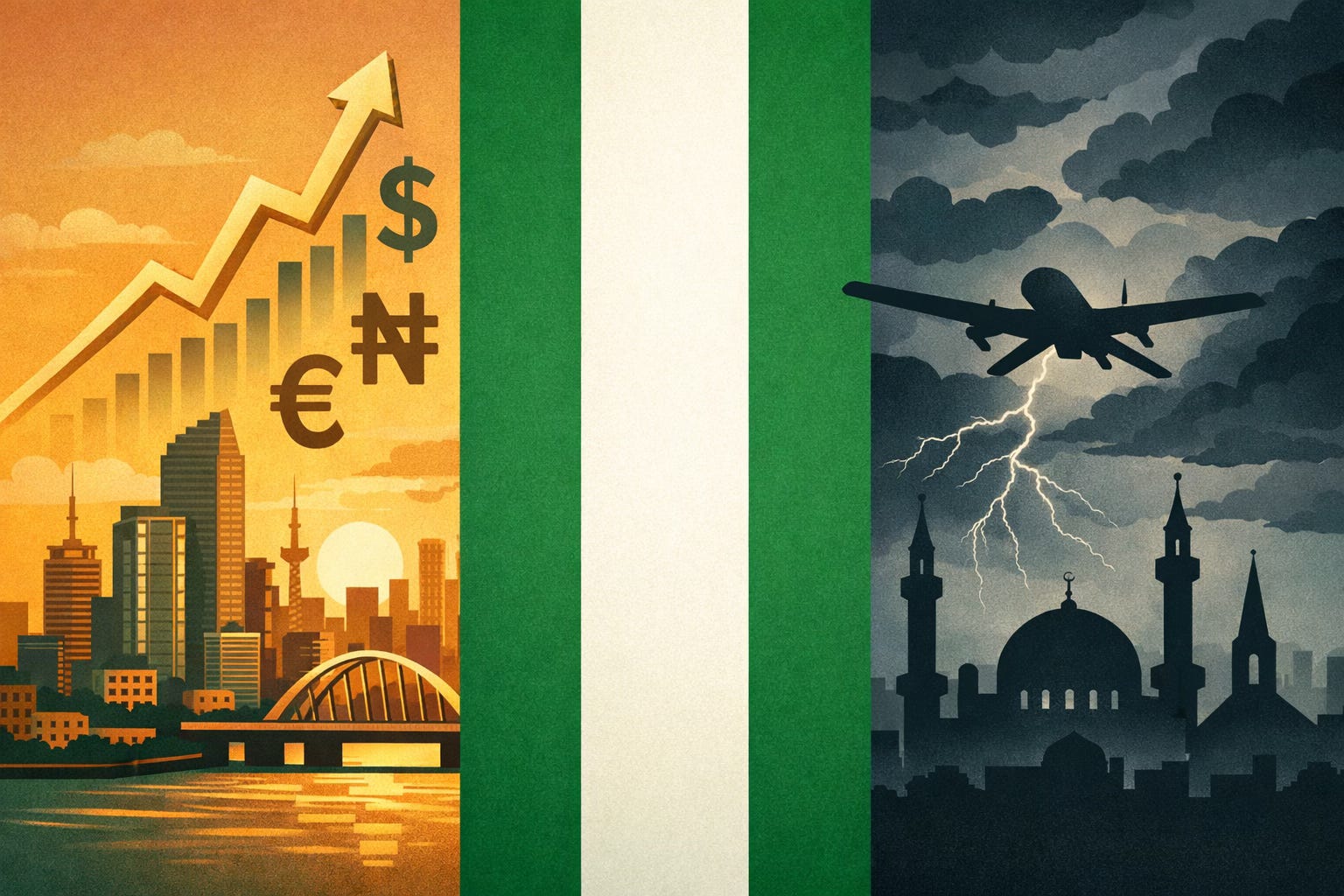
The final week of 2025 will be remembered as the moment when American firepower arrived on Nigerian soil—and when the contradictions of President Bola Tinubu’s reformist agenda came into sharp relief. As Nigerians marked Christmas, Tomahawk missiles struck ISIS camps in Sokoto State in the country’s northwest, a suicide bomber killed five worshippers in Maiduguri, and a constitutional row erupted over whether tax laws had been secretly altered after parliamentary passage. Yet beneath the drama, Nigeria’s economy continued its improbable stabilisation: inflation fell to 14.45%, foreign reserves hit a seven-year high, and the naira held steady. Africa’s most populous nation enters 2026 battered but not broken, its trajectory as uncertain as ever.
The week’s dominant story—unprecedented US airstrikes coordinated with the Tinubu government—marks a watershed in Nigerian security policy. For decades, Abuja jealously guarded its sovereignty, rebuffing Western offers of military assistance. Now, faced with expanding jihadist violence and the Trump administration’s aggressive framing of a “Christian genocide,” Nigeria chose pragmatism over pride. The implications will reverberate well into 2026.
Politics and governance
A constitutional crisis over tax reform
What should have been a straightforward implementation of Nigeria’s new tax laws became a constitutional flashpoint. Representative Abdussamad Dasuki of the opposition PDP alleged that four tax reform bills—signed into law earlier in 2025—had been altered between their passage by the National Assembly and their gazetting. The controversy strikes at the heart of legislative authority in Africa’s largest democracy.
The House of Representatives responded by constituting a seven-man ad hoc committee to investigate, while directing the re-gazetting of the affected laws. The Nigerian Bar Association, led by President Afam Osigwe, warned that the allegations “cast doubt on the integrity, transparency and credibility of Nigeria’s lawmaking process.” The House Minority Caucus called for suspension of implementation pending investigation.
President Tinubu was unmoved. In a personally signed statement on December 30, he insisted the new tax laws would take effect on January 1, 2026, as scheduled. “The new tax laws... will continue as planned,” he declared—a characteristic display of the stubbornness that has defined his presidency. The standoff illustrates the tension between Tinubu’s impatience for reform and institutional constraints designed to check executive power.
NNPC’s massive debt write-off
In quieter but equally consequential news, Tinubu approved the cancellation of approximately $5.27 billion in debt owed by the Nigerian National Petroleum Company Limited. The write-off—comprising $1.42 billion in dollar-denominated liabilities and ₦5.57 trillion in naira debt—covers obligations through December 2024, including production-sharing contracts and joint venture royalties. The move is part of Tinubu’s effort to clean up NNPC’s opaque books ahead of planned asset sales, though critics note that a disputed $42 billion under-remittance from 2011-2017 remains unresolved.
Rivers State’s unending political soap opera
The political feud between FCT Minister Nyesom Wike and Rivers State Governor Siminalayi Fubara—both ostensibly allies of President Tinubu—showed no signs of abating. At a media chat in Port Harcourt on December 29, Wike mocked Fubara’s December defection to the ruling APC as arriving “too late” and “without any political structure.” The APC now controls 27 of Nigeria’s 36 governorships, but the Rivers situation demonstrates that party dominance does not guarantee internal cohesion.
Economy and business
Inflation’s retreat and the naira’s stability
Nigeria’s economic trajectory at the end of 2025 signaled a period of aggressive stabilisation. November headline inflation fell to 14.45%—a significant drop from 24.48% in January and the eighth consecutive monthly decline. This trend was mirrored in food inflation, which was reported at 11.08%, a stark mathematical improvement from the 39.93% recorded a year earlier.
However, analysts note that these “plunging” figures were heavily influenced by the Central Bank’s early-2025 rebasing of the Consumer Price Index (CPI), which updated consumption baskets to more accurately reflect modern spending. Despite this statistical relief, the Central Bank maintained its hawkish stance, holding the policy rate at 27%. By keeping the monetary policy rate high while inflation cooled, Nigeria ended the year with a real interest rate of approximately 12.5%—one of the highest globally—a move designed to lock in foreign investment and prevent a return to the currency volatility of 2024.
The naira closed the year at approximately ₦1,448/$ in the official market, with the parallel market spread narrowing to under 2%—compared to over 60% a year ago. Foreign reserves reached $45.24 billion by December 23, up 7.28% month-on-month and the highest level in nearly seven years. Diaspora remittances surged to $23 billion for the year, a five-year high that reflects both improved formal channels and the economic desperation driving emigration.
Stock market approaches historic milestone
The Nigerian Stock Exchange delivered its strongest performance since 2020, with the All-Share Index returning 49.17% year-to-date. Market capitalisation approached ₦100 trillion—a psychological threshold that would have seemed fantastical during the dark days of 2024. Holiday-shortened trading saw investors add ₦953 billion to portfolios during the week. The Centre for the Promotion of Private Enterprise projects GDP growth of 4.0-4.5% in 2026, though analysts caution that pre-election fiscal pressures and persistent insecurity remain significant risks.
Dangote Refinery reshapes the fuel market
The 650,000 barrel-per-day Dangote Refinery continued its transformation of Nigeria’s fuel economy. December saw petrol prices fall significantly, with the refinery’s ex-depot price dropping from ₦828 to ₦699 per litre. NNPC retail outlets sold at ₦785 in Lagos and ₦835 in Abuja—down from ₦820 and ₦915 respectively. Nigeria now boasts the cheapest petrol in West Africa, an ironic achievement for a country that imported virtually all its refined fuel just two years ago. The refinery committed to supplying 50 million litres daily through January, rising to 57 million litres by February.
Security and defence
American firepower targets Nigerian jihadists
The most dramatic development of the week—indeed, of the entire Tinubu presidency—came in the early hours of December 26, when American Tomahawk missiles and Reaper drone munitions struck Islamic State camps in Sokoto State’s Bauni forest. The operation, announced by President Trump on Christmas Day as a “present” to terrorists, represented the first direct US military intervention on Nigerian soil.
Foreign Minister Yusuf Tuggar confirmed he had spoken with Secretary of State Marco Rubio before the strikes, while AFRICOM commander General Dagvin Anderson emphasised coordination with Nigerian authorities. Information Minister Mohammed Idris Malagi declared the targets—two ISIS-Sahel Province and affiliated Lakurawa enclaves—“successfully neutralised.” Missile debris fell in Jabo village in Sokoto State and near a hotel in Offa, Kwara State, though no civilian casualties were reported.
The strikes followed months of Trump administration pressure over alleged Christian persecution and Nigeria’s October designation as a “Country of Particular Concern” under US religious freedom law. Nigeria’s government walked a careful line: accepting American help while rejecting the sectarian framing. “This is not about religion,” Tuggar insisted. “It is about Nigerians, innocent civilians, and the wider region.”
Maiduguri bombing signals Boko Haram resilience
Christmas Eve brought tragedy to Maiduguri when a suicide bomber attacked Al-Adum Juma’at Mosque during evening prayers, killing five worshippers and injuring 35. The attack—the first major bombing in the Borno State capital since 2021—demonstrated Boko Haram’s continuing capacity to strike urban areas despite years of military pressure. Vice President Kashim Shettima personally visited victims in hospital, while President Tinubu ordered an immediate intensification of security operations.
Kidnapping persists across the north
The week saw continued kidnapping activity, though also some resolution. The final 130 students abducted from St. Mary’s Catholic School in Niger State on November 21 were released on December 22—described by Bishop Bulus Dauwa Yohanna as “a Christmas gift.” The original mass kidnapping of 303 students represented the largest school abduction in Nigerian history. Meanwhile, Operation WHIRL STROKE troops rescued 24 passengers from kidnappers on the Otukpo-Enugu highway, while a joint security operation foiled an attempted mass abduction in Zamfara State’s Maru metropolis on December 28.
Society and culture
A Christmas of contrasts
The Christian Association of Nigeria’s president, Archbishop Daniel Okoh, met President Tinubu on December 27 and offered a cautiously optimistic assessment: 2025 was “the first Christmas in many years that we are not woken up with a phone call in the midnight to say that a church was attacked.” The Maiduguri mosque bombing—targeting Muslims—served as a grim reminder that jihadist violence transcends sectarian boundaries.
Economic pressures shaped celebrations. Prices rose over 30% year-on-year, prompting Archbishop Henry Ndukuba to advise frugality: “Don’t spend all you have in order to celebrate Christmas. Know that by January, we will be paying house rent, we will be paying school fees.” The transformation of Nigerian Christmas—from family-centred religious observance to commercialised, social media-driven spectacle—continued apace.
Super Eagles soar in Morocco
On the pitch, Nigeria’s Super Eagles delivered a perfect group-stage campaign at the Africa Cup of Nations in Morocco. Victories over Tanzania (2-1), Tunisia (3-2), and Uganda (3-1) secured top spot in Group C with nine points—the only team to win all three matches. Victor Osimhen ended his goal drought against Tunisia, while Wilfred Ndidi scored his first international goal. The Nigerian Football Federation’s mandate to coach Eric Chelle: reach the final.
Entertainment milestones
The entertainment industry capped a strong year. HBO’s documentary “Wizkid: Long Live Lagos” premiered on Showmax over the Christmas weekend, chronicling the Grammy-winner’s journey from Surulere to global superstardom. Nollywood saw a competitive “December Showdown” at the box office, with Funke Akindele’s “Behind The Scenes” crossing ₦512 million in its first two weeks. The posthumous announcement that Fela Kuti would receive a Lifetime Achievement Award at the 2026 Grammys added to the sense of Afrobeats’ global triumph.
Technology, infrastructure, and innovation
Grid collapse dampens year-end optimism
Nigeria’s power sector delivered a characteristically unwelcome reminder of its fragility on December 29, when the national grid collapsed for the fourth time in 2025. Generation crashed from 4,800 MW to just 139 MW at 2:01 PM, with only 50 MW distributed nationwide. Multiple distribution companies received zero megawatts. The collapse—blamed partly on the vandalism of the Escravos-Lagos Pipeline System earlier in December—underscored the structural constraints that continue to hobble Nigerian industry despite reform rhetoric.
Lagos-Calabar Highway secures historic funding
Better news came on December 26, when First Abu Dhabi Bank confirmed $1.26 billion in financing for the first section of the Lagos-Calabar Coastal Highway. The 56km stretch represents the first Nigerian road project of this scale fully backed by international financiers—a vote of confidence in Tinubu’s infrastructure agenda. The complete 700km highway will connect nine coastal states, incorporating rail lines through its centre.
Fintech ecosystem matures
The tech sector continued its steady evolution. Nigerian fintech Clea launched from stealth on Christmas Eve, having processed $4 million in blockchain-powered cross-border transactions during its pilot phase. PayPal announced plans to return to Nigeria—a “too late to the party” narrative given the maturation of local champions like Moniepoint (now valued at over $1 billion). MTN Nigeria expanded its 5G offerings, though penetration remains under 3% of mobile subscribers amid high infrastructure costs and weak consumer demand.
International relations
A new chapter in US-Nigeria ties
The Christmas airstrikes represented a fundamental shift in Nigeria’s security posture. For decades, successive governments had rejected Western military assistance as neocolonial overreach. Tinubu’s pragmatic acceptance of American firepower—while maintaining that the operation targeted “foreign ISIS-linked elements” rather than domestic insurgents—suggests a recognition that ideology cannot defeat jihadists armed with drones and night-vision equipment.
The diplomatic choreography was notable: Foreign Minister Tuggar’s 19-minute call with Secretary Rubio before the strikes, followed by a five-minute follow-up. Defense Secretary Pete Hegseth promised “more to come.” Whether this represents sustainable partnership or a one-off intervention ahead of Trump’s broader Africa policy remains unclear.
West Africa's uneasy equilibrium
Regional dynamics remained complicated. At the 68th Ordinary Session on December 14, ECOWAS approved a creative workaround for the departed Sahel states: Burkina Faso, Mali, and Niger would remain members of GIABA, the regional anti-money laundering body, despite their formal exit. Earlier in the month, Nigeria had deployed fighter jets and ground troops to help thwart a coup attempt in Benin—a reminder that Abuja remains the security guarantor of last resort for its smaller neighbours.
The Senate’s confirmation of 64 ambassadorial nominees on December 18 ended a two-year absence of Nigerian envoys at key postings including China, India, and the UN. “The era of timid foreign policy is over,” declared an APC spokesman. “The era of strategic, assertive diplomacy has begun.”
FDI surge and FATF exit
Foreign direct investment surged 700% quarter-on-quarter in Q3 2025 to $720 million, while Nigeria’s exit from the FATF grey list removed the “dirty money destination” tag that had deterred legitimate investment. Total capital importation reached $14.78 billion in the first eight months of 2025—a 118% year-on-year increase, though portfolio investment dominates at 86%.
The week ahead
The first week of 2026 brings implementation challenges and continued uncertainty. The contested tax reforms take effect on January 1, setting up potential legal battles if the House investigation finds evidence of post-passage alterations. President Tinubu will attend the Abu Dhabi Sustainability Week Summit, his 15th international trip of 2025—drawing criticism from opposition figures who question his priorities amid security concerns.
The Super Eagles face their Round of 16 opponent at AFCON 2025, with NFF pressure mounting for a deep tournament run. NNPC aims to restore full pipeline capacity following the Escravos-Lagos repairs, while Dangote Refinery’s turnaround maintenance on its main gasoline unit continues through late January. The House ad hoc committee on tax law alterations is expected to report findings that could either vindicate the government or deepen the constitutional crisis.
For Nigeria, 2026 begins as 2025 ended: reform and crisis, progress and setback, inextricably intertwined. The world’s sixth most populous country—and one of Africa’s largest economies—continues to defy easy characterisation. American missiles may have struck Sokoto, but the harder battles remain domestic: building institutions that can withstand political pressure, delivering services to over 235 million citizens, and converting macroeconomic stabilisation into prosperity that ordinary Nigerians can feel. On those fronts, the verdict remains out.