

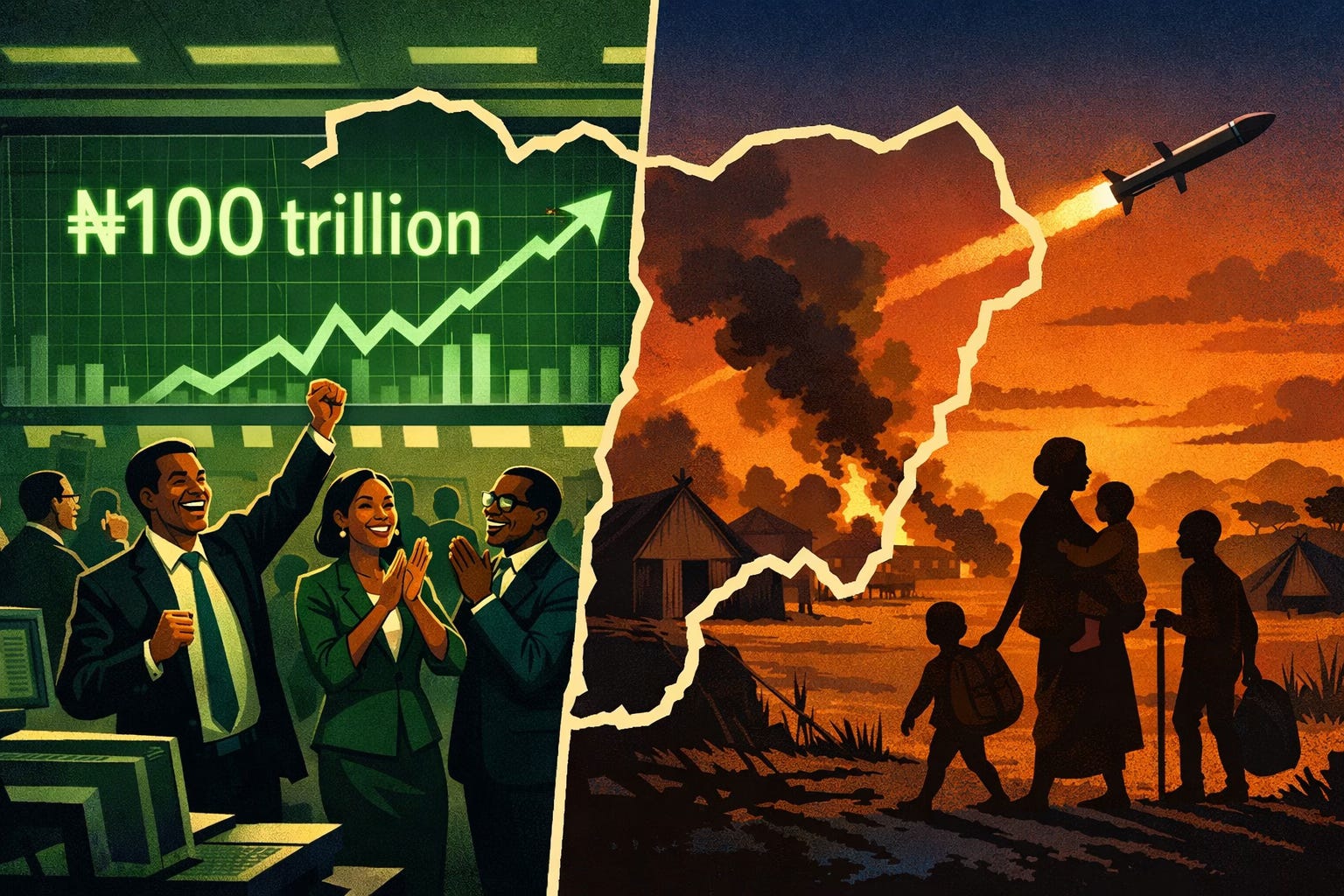
When American Tomahawk missiles struck ISIS camps in northwestern Nigeria on Christmas Day, the most remarkable aspect was how unremarkable the response proved. President Bola Tinubu’s government hailed the strikes as partnership; his critics grumbled about sovereignty. By week’s end, the conversation had moved on—even as bandits massacred 50 villagers in Niger State and the ruling party absorbed yet another opposition governor. Meanwhile, in Lagos, the stock market crossed ₦100 trillion for the first time. Nigeria entered 2026 the way it spent much of 2025: a country simultaneously booming and burning, reforming its economy while outsourcing its security, consolidating political power while ceding military authority.
Politics and governance
The APC’s march toward dominance continues
Governor Caleb Mutfwang of Plateau State formally joined the APC on January 2nd, receiving his membership card at Government House in Jos after submitting his resignation from the People’s Democratic Party (PDP) on December 29th. His defection—citing the need for “better alignment with federal government policies”—brought all six North-Central states under APC governors and reduced the PDP to a rump of perhaps four or five states, down from twelve at the start of 2023.
The pattern is now familiar. Governors Siminalayi Fubara (Rivers), Peter Mbah (Enugu), Umo Eno (Akwa Ibom), Sheriff Oborevwori (Delta), and Agbu Kefas (Taraba) have all abandoned the PDP this political season. Kano’s Governor Abba Kabir Yusuf appears poised to leave the New Nigeria People’s Party next. The APC now controls approximately 30 of 36 states—a dominance unseen since the military era. Opposition figures warn of a slide toward one-party rule; the government counters that defectors are simply following their constituents’ wishes.
Rivers State remains the exception that tests the rule
The Wike-Fubara feud—Nigeria’s most combustible intra-party conflict—intensified. FCT Minister Nyesom Wike declared Governor Fubara would receive “no second chance” during a visit to his Ogba/Egbema/Ndoni stronghold on January 2nd. By January 5th, Rivers Deputy Governor Ngozi Odu and Secretary to the State Government Benibo Anabraba had defected to the APC. Wike then declared Rivers a political “no-go area” for the APC national leadership, warning party secretary Ajibola Basiru: “Your hand will burn.”
The spectacle reveals the limits of the defection wave. Governors may switch jerseys, but local power brokers retain influence. Wike’s effective control of Rivers’ political machinery—despite holding federal office—demonstrates that patronage networks survive party labels. For Tinubu, managing these rivalries while maintaining APC cohesion before 2027 presents a delicate challenge.
Tax reforms arrive amid controversy
Nigeria’s most ambitious tax overhaul in decades took effect on January 1st. The Nigeria Tax Act and Nigeria Tax Administration Act promise relief for 98% of workers from Pay-As-You-Earn obligations and exempt 97% of small businesses from corporate income tax, VAT, and withholding tax. The reforms replace the Federal Inland Revenue Service with a new Nigeria Revenue Service.
Yet controversy shadows the implementation. Representative Abdulsamad Dasuki alleged discrepancies between laws passed by the National Assembly and the gazetted versions, prompting a House investigation. Civil society groups demanded publication of budget estimates and unconditional presidential commitment to constitutional spending limits. Taiwo Oyedele, chairman of the Presidential Committee on Fiscal Policy and Tax Reforms, dismissed concerns, noting the reforms were “designed to provide relief for the majority of Nigerians.”
Economy and business
The naira stabilises as inflation retreats
The macroeconomic picture, while hardly rosy, shows unmistakable improvement. Inflation fell to 14.45% in November 2025—the eighth consecutive monthly decline and the lowest reading since October 2020. The naira traded at ₦1,431.47 per dollar on January 6th, having strengthened roughly 7% from its historic low of ₦1,717.50 in late 2024. Foreign reserves reached $45.4 billion by December 29th, a seven-year high.
These figures vindicate the Central Bank’s hawkish stance under Governor Olayemi Cardoso. The 27% monetary policy rate and 45% cash reserve ratio have been punishing for businesses but effective against inflation. The CBN’s 2026 outlook projects inflation averaging 12.94%, reserves climbing to $51.04 billion, and GDP growth of 4.49%. Whether the bank eases policy before the 2027 election—introducing stimulus that could reignite price pressures—remains the critical monetary question.
Stock market crosses historic threshold
The Nigerian Exchange celebrated a milestone on January 5th when market capitalisation exceeded ₦100 trillion for the first time, settling at ₦101.8 trillion. The All-Share Index returned 51.19% in 2025, the strongest performance in nearly two decades. Banking sector recapitalisation—with 16 of 34 commercial banks already meeting new requirements ahead of the March 2026 deadline—has driven much of the activity. A potential listing of the Dangote Refinery could prove the “defining market event” of 2026, according to analysts.
Dangote Refinery maintains momentum
The 650,000 barrel-per-day refinery continued supplying 40-50 million litres of petrol daily despite a planned maintenance turnaround on its gasoline unit. An expansion to 700,000 bpd—which would make it the world’s eighth-largest—proceeds alongside operations. The facility has reduced Nigeria’s petrol imports by over 60% and maintains an ex-gantry price of ₦699 per litre, below the government’s ₦740 target. For a country that historically exported crude oil only to import refined products, the refinery represents perhaps the Tinubu era’s most consequential infrastructure achievement.
Security and defence
American strikes and their aftermath
The most dramatic development of the period occurred before it technically began. On Christmas Day, at President Trump’s direction, US Africa Command launched 12-plus Tomahawk missiles from the USS Paul Ignatius in the Gulf of Guinea, supplemented by MQ-9 Reaper drone strikes, against ISIS-linked Lakurawa camps in Sokoto State’s Tangaza district. Trump framed the operation as protection for “innocent Christians” targeted by terrorists.
Nigeria’s response was carefully calibrated. Foreign Minister Yusuf Maitama Tuggar called it a “joint operation” having “nothing to do with a particular religion.” Information Minister Mohammed Idris described “successfully conducted precision strike operations.” The government emphasised sovereignty was respected through advance coordination. Northern elites criticised the strikes; Christian leaders welcomed them. Residents of Jabo village, near where debris fell, expressed bewilderment—their predominantly Muslim farming community, they said, has “no known history” of ISIS presence.
Banditry claims 50 lives in Niger State
Any sense that the American strikes might signal a turning point evaporated on January 4th when bandits attacked Kasuwan Daji market in Demo village, Niger State, killing at least 50 people and abducting others. Victims were found with hands bound; market stalls were burned. President Tinubu’s office suggested the attackers may have been terrorists fleeing the Sokoto strikes—a theory that, if accurate, illustrates the “balloon effect” of counterterrorism operations that disperse rather than destroy militant networks.
The attack followed a grim pattern. On New Year’s Eve, assailants killed seven people in Plateau State’s Bum community as residents prepared to welcome 2026. In Katsina State, attacks in Unguwar Naino, Unguwar Daudu, and Malumfashi claimed additional lives despite recent “peace deals” with bandits. A veteran photojournalist was kidnapped in Kaduna on January 5th.
Boko Haram maintains lethal capability
In the northeast, Boko Haram demonstrated continued capacity for violence. An IED attack near Gubio, Borno State, killed nine soldiers from the 145 Damasak Battalion on January 4th-5th. Troops intercepted three suicide bombers on the Guduf-Pulka axis on New Year’s Day, recovering suicide vests and four AK-47 rifles. The Nigerian Air Force claimed 274 precision strikes in 2025, neutralising over 2,351 terrorists—figures that suggest tactical success but strategic stalemate.
Society and culture
Super Eagles advance at AFCON
Nigeria’s sporting fortunes provided rare uplift. The Super Eagles achieved their first perfect group-stage record in 20 AFCON participations, defeating Tunisia, Tanzania, and Uganda (3-1 on December 31st) to advance from Group C. Captain Victor Osimhen declared Nigeria “ready to trample on any team” ahead of the Round of 16 match against Mozambique on January 5th in Fes. The country seeks to end a 13-year drought since its last continental title in 2013.
Education sector breakthrough
Education Minister Tunji Alausa announced the government will formally sign the long-delayed 2009 FGN-ASUU Agreement on January 14th. Key provisions effective January 1st include a 40% salary increase for academic staff and retirement at age 70 for professors. The minister’s observation that strikes have cost some students “almost four academic years” captures the dysfunction that has plagued Nigerian universities. Whether implementation follows remains to be seen.
Nollywood box office strength
Funke Akindele’s “Behind The Scenes” became the highest-grossing Nigerian film of 2025 at ₦1.767 billion in under four weeks, breaking five opening-weekend records including highest single-day gross on Boxing Day (₦129.5 million). The achievement underscores Nollywood’s commercial maturation even as Netflix and other platforms reshape distribution.
Technology, infrastructure and innovation
Flutterwave acquires Mono in rare African exit
Africa’s largest fintech, Flutterwave, acquired Nigerian open banking startup Mono in an all-stock deal valued at $25-40 million on January 5th. Mono had raised approximately $17.5 million from Tiger Global, General Catalyst, and Target Global. The “Plaid for Africa” has powered over 8 million bank account linkages, covering roughly 12% of Nigeria’s banked population. Early investors reportedly realised returns of up to 20x—a rare exit in an ecosystem starved of them.
Nigeria slips in African funding rankings
Despite the Flutterwave-Mono deal, Nigeria dropped to fourth place among African startup funding destinations in 2025, raising $410.1 million compared to Kenya’s $933.6 million leadership. Currency volatility, inflationary pressures, and sparse exit opportunities have pushed investors toward Nigerian companies with global operations rather than domestic-focused plays.
Infrastructure push continues
The 2026 budget allocates ₦3.56 trillion to infrastructure, with major projects including the 164km Abuja-Kaduna-Zaria-Kano Dual Carriageway (target completion 2026), the 107km Enugu-Onitsha Expressway funded through MTN’s tax credit scheme, and the ambitious $11.17 billion Lagos-Calabar Coastal Highway. The World Bank’s $1.6 billion BRIDGE project aims to expand broadband across all 774 local government areas.
International relations
Nigeria asserts regional leadership in Benin
December’s successful military intervention to thwart a coup in Benin Republic—Nigeria’s first foreign intervention since Gambia in 2017—reasserted the country’s regional primacy and ECOWAS’s relevance after the bloc’s failure to stop coups in Mali, Niger, Burkina Faso, and Guinea. President Tinubu dispatched fighter jets and ground troops within hours of President Patrice Talon’s request; the coup collapsed within hours with 14-plus arrests.
The intervention carried risks. Those Sahel Alliance states viewed the operation as French-engineered interference, potentially deepening the regional rift. A Nigerian military aircraft’s unscheduled landing in Burkina Faso caused a brief diplomatic incident. Yet for a bloc whose credibility had been shattered by four successful coups in four years, the Benin operation demonstrated that collective security mechanisms could still function—when Nigeria chose to activate them.
US relations enter complex phase
The Christmas strikes coincided with new US visa restrictions effective January 1st, partially suspending B-1/B-2 visitor visas and F/M/J student visas for Nigerian nationals. Nigeria was among 19 countries affected—26 of 39 total restricted nations are African—following its redesignation as a “Country of Particular Concern” for religious freedom violations. Yet a $5.1 billion health cooperation MoU (with $2.1 billion in US grants) signed in late December signals continued engagement. Nigeria’s relationship with the Trump administration will require careful navigation.
ECOWAS implements air transport reforms
A landmark ECOWAS policy took effect January 1st, removing all taxes on air transport and mandating a 25% reduction in passenger and security charges across member states. West Africa ranks as the world’s most expensive region to fly, with 64-70% of ticket prices driven by taxes. Nigeria ranks among the top ten globally. Whether airlines pass savings to consumers or preserve margins remains to be seen.
The week ahead
The coming week presents several inflection points for Nigeria:
January 7-10: The INEC continuous voter registration Phase 2 continues, with 2,572,054 Nigerians having completed registration in Phase 1. The process runs until August 30th, 2026.
January 12: ASUU watch begins as the National Association of Resident Doctors threatens to resume its indefinite strike over unmet demands. Schools in “safe areas” of Niger State are scheduled to reopen.
January 14: The Federal Government is scheduled to sign the 2009 FGN-ASUU Agreement—a ceremony that could mark a breakthrough or another false dawn for Nigerian higher education.
Economic releases: Markets will watch for December inflation data, which could extend the disinflation streak to nine months, and updates on oil production figures as Nigeria targets 1.84 million barrels per day for budget purposes.
Wildcards: Security remains the primary wildcard. The Niger State massacre suggests displaced militants may strike in unexpected locations. The 2027 election cycle is accelerating, which historically correlates with increased political violence. And Nigeria’s complex dance with the Trump administration—simultaneously receiving military strikes and visa restrictions—could shift in unpredictable directions.
Nigeria begins 2026 with its contradictions fully on display: a stock market at record highs while bandits massacre villagers; a currency stabilising while workers emigrate; a regional leader that requires American missiles to target insurgents in its own northwest. The year ahead will test whether the Tinubu administration’s reforms can translate macroeconomic improvement into security and prosperity that Nigerians actually experience—or whether the gap between Lagos’s gleaming towers and the villages burning in Borgu will only widen.