

The country’s economic reforms show results as opposition parties collapse into the ruling APC, while diplomatic tensions with Washington give way to a landmark health partnership.
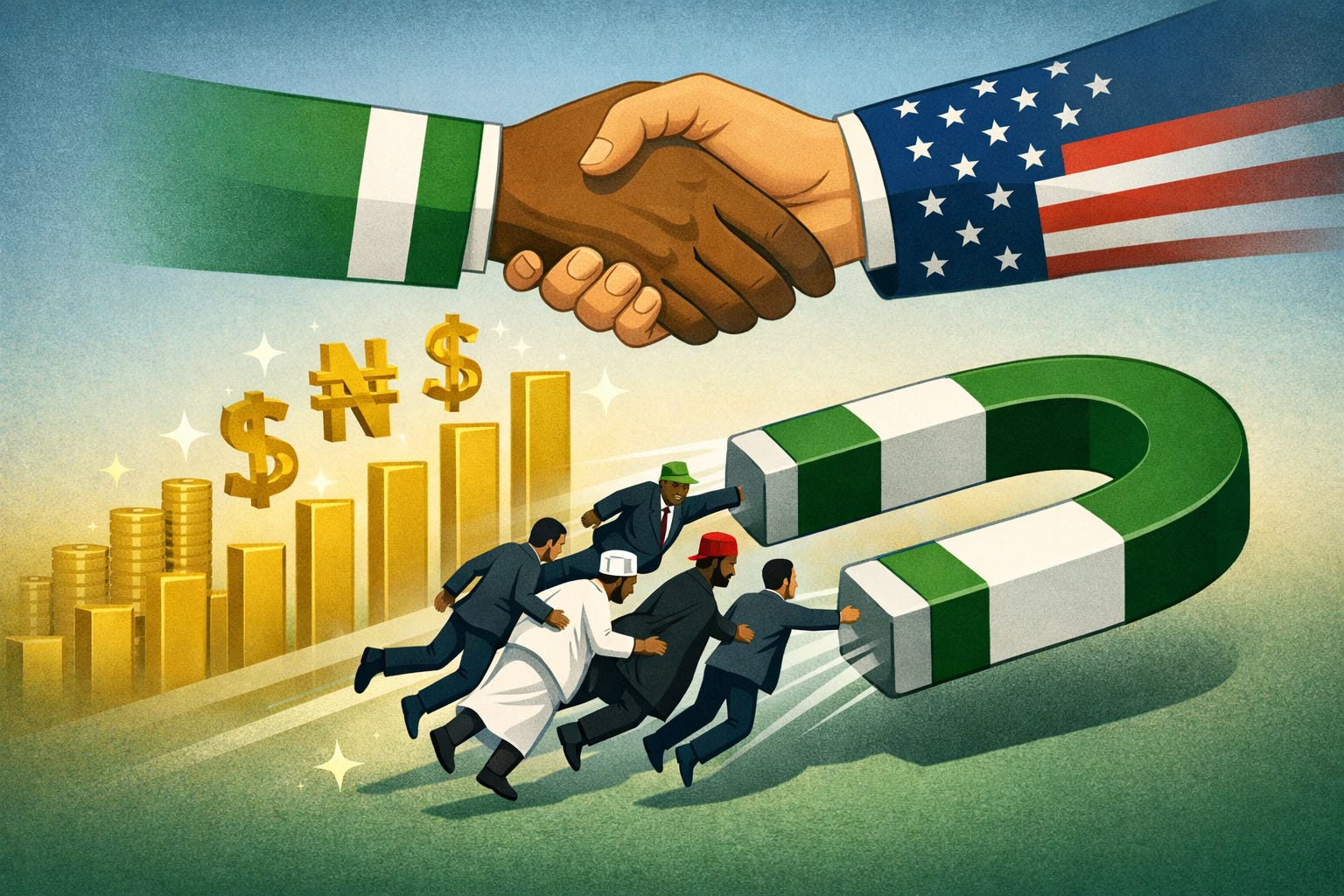
Nigeria enters the Christmas season with an unusually crowded political tent. President Bola Tinubu’s ruling All Progressives Congress has absorbed so many opposition governors and lawmakers in recent weeks that critics warn the country is sliding toward “one-party rule.” Yet beneath the political theatre, harder numbers tell a more encouraging story: inflation has fallen to 14.45%, foreign reserves have climbed to a seven-year high, and the stock market has returned nearly 48% this year.
Politics & Governance
A budget built on consolidation
President Tinubu stood before a joint session of the National Assembly on December 19 to present a ₦58.18 trillion($41.6 billion) spending plan for 2026—his administration’s most ambitious fiscal blueprint yet. Themed “Budget of Consolidation, Renewed Resilience and Shared Prosperity,” the proposal allocates ₦5.41 trillion to security (the largest sectoral share), ₦3.56 trillion to infrastructure, and ₦3.52 trillion to education. Defence spending, unsurprisingly, dominates; Nigeria’s overlapping insurgencies demand it.
The budget assumes crude oil production of 1.84 million barrels per day at a benchmark price of $64.85 per barrel, with an exchange rate of ₦1,400 to the dollar—conservative enough to be credible. Revenue projections total ₦34.33 trillion, leaving a deficit of ₦23.85 trillion (4.28% of GDP), to be financed through domestic and external borrowing.
From fragmented to focused budgeting
Tinubu declared that Nigeria would transition to a single annual budget cycle from April 2026, ending the chaotic practice of overlapping appropriations. “The true value of a budget is not in its announcement, but in its delivery,” he noted—a tacit acknowledgment that execution has been Nigeria’s perennial weakness.
More consequentially, Tinubu announced that armed groups across the country—“bandits, kidnappers, militias, violent cults and their sponsors”—would be designated as terrorists. The declaration carries legal weight, potentially enabling more aggressive military action and asset seizures. Whether it translates into improved security remains to be seen.
The opposition’s great vanishing act
The bigger political story is the systematic hollowing-out of Nigeria’s opposition. Seven governors have defected from the People’s Democratic Party and Labour Party to the APC in late 2025, including Siminalayi Fubara of Rivers State, whose December defection brought with him two senators and ten House of Representatives members this week alone. By December 23, only three PDP lawmakers from Rivers remained in the House.
“Has hunger defected?”
The scale of defections has alarmed civil society. The Centre for Human Rights and Civic Education warned that Nigeria is “evolving into a one-party system”—a “civilian dictatorship cloaked in democratic garb.” Governor Seyi Makinde of Oyo State, one of the few remaining opposition figures, questioned whether defections addressed citizens’ concerns. “Has hunger defected?” he asked pointedly. “We run the risk of an Arab Spring.”
The Supreme Court’s December 15 ruling on emergency powers provided context for the political consolidation. Though the justices struck out a challenge to Tinubu’s March 2025 emergency declaration in Rivers State on procedural grounds, they affirmed—in what critics called mere “judicial discussion”—the president’s constitutional authority to declare emergencies and suspend elected officials. Five of the eleven plaintiff governors had already defected to the APC by the time the ruling was delivered; two more followed immediately afterward. The opposition’s legal ammunition, it seems, has run dry.
Economy & Business
An economy finding its feet
If politics disappointed democrats, economics offered some consolation. November’s headline inflation fell to 14.45%—the eighth consecutive monthly decline and below the 15% target Tinubu set at his inauguration. Food inflation dropped even more dramatically, to 11.08%, from nearly 40% a year earlier. Core inflation touched 18.04%, its lowest since February 2023.
The disinflation reflects painful but necessary reforms: the removal of fuel subsidies, the unification of exchange rates, and tighter monetary policy. The Central Bank of Nigeria has held its benchmark rate at 27% since September, when it delivered a surprise 50-basis-point cut—the first since 2020. Foreign reserves have climbed to approximately $46.7 billion, their highest level in nearly seven years, sufficient to cover more than ten months of imports.
Markets reward reform
The Nigerian Exchange has been a beneficiary. The All-Share Index closed at 152,057 on December 20, up 1.13% for the week and a remarkable 47.73% for the year. Market capitalisation reached ₦96.9 trillion. The rally reflects both improved macroeconomic fundamentals and the re-rating of Nigerian assets following the country’s exit from the Financial Action Task Force’s grey list earlier this year—a development that avoided an estimated $30 billion in foregone investment.
Naira stability—at last?
Currency stability, the holy grail of Nigerian economic policy, remains elusive but improved. The naira traded at approximately ₦1,454-1,456 to the dollar in the official market on December 23, with parallel-market rates hovering around ₦1,480-1,496—a spread far narrower than the chasms of previous years. The CBN’s new electronic foreign-exchange matching system and Nigeria Foreign Exchange Code are designed to rebuild confidence in a market long plagued by opacity.
Oil’s revival
The oil sector, Nigeria’s fiscal backbone, has staged a modest recovery. NNPC E&P Limited achieved daily production of 355,000 barrels on December 1—its highest output since 1989 and a 52% increase from 2023 levels. The government targets two million barrels per day by 2027 and three million by 2030, though security challenges in the Niger Delta and ageing infrastructure make such ambitions uncertain.
Dangote’s dominance
The more transformative story is Dangote Refinery. Africa’s largest petroleum refinery is now processing 650,000 barrels per day and producing 50 million litres of petrol daily. On December 11, Dangote reduced its gantry price by 16% to ₦699 per litre, forcing competitors to respond. By December 22, petrol was selling at ₦739 per litre at over 2,000 MRS stations nationwide—still expensive by historical standards, but down from peaks above ₦800.
Aliko Dangote has announced plans to expand the refinery to 1.4 million barrels per day by 2028, partnering with Honeywell for technology. If successful, Nigeria would transition from a chronic fuel importer to a net exporter—a structural shift that could reshape the country’s balance of payments and fiscal arithmetic for decades.
Security & Defence
Security’s mixed ledger
The release of 130 kidnapped schoolchildren from St. Mary’s Catholic School in Niger State on December 21 provided Nigeria a rare moment of relief. The students, seized alongside their teachers in November in the single largest school kidnapping in Nigerian history, were freed after what the government described as a “military-intelligence operation.” Officials declined to confirm whether ransom was paid, though unofficial reports suggested approximately ₦1 billion ($688,000) changed hands for the first group released on December 7.
Yet the rescue underscored the underlying crisis. Between July 2024 and June 2025, kidnappers collected $1.66 million in confirmed ransoms, according to SBM Intelligence. The Northwest remains an epicentre: Zamfara State alone recorded 1,088 fatalities and 1,755 abductions in 2025. An estimated 30,000 bandits operate from over 100 camps in the state, funded partly by proceeds from illegally controlled gold mines.
Northeast insurgency grinds on
In the Northeast, the military claimed success against Boko Haram and its rival, the Islamic State West Africa Province. On December 21-22, troops neutralized 21 terrorists in Borno State after intercepting a logistics convoy. Yet the insurgency remains lethal: since launching “Camp Holocaust” earlier this year, ISWAP has conducted over 200 attacks, killing at least 500 people and overrunning more than 15 military outposts.
International Relations
A diplomatic reset with Washington
Relations with the United States, strained since President Trump designated Nigeria a “Country of Particular Concern” for religious freedom and threatened military intervention over alleged “Christian genocide,” appear to have thawed. Information Minister Mohammed Idris announced on December 22 that differences had been “fully resolved through constructive dialogue.”
$5.1bn health partnership seals détente
The rapprochement found concrete expression in a $5.1 billion health cooperation agreement signed December 19-20. The United States committed nearly $2.1 billion in grants through 2030 for HIV/AIDS, tuberculosis, malaria, and maternal health programmes; Nigeria pledged $3 billion in domestic health expenditure—described as the largest co-investment any country has made under America’s new global health strategy. Notably, $200 million was earmarked for Christian faith-based healthcare facilities, a concession to the religious freedom concerns that had driven tensions.
Society & Culture
The cultural economy roars
Lagos’s December transformation into a party destination—”Detty December” in local parlance—offered a counterpoint to grim security headlines. The Flytime Music Festival celebrated its 20th anniversary at Eko Convention Centre; diaspora Nigerians returned in record numbers; and the Super Eagles opened their AFCON 2025 campaign with a 2-1 victory over Tanzania on December 23, goals from Semi Ajayi and Ademola Lookman securing three points.
Nollywood breaks records
Nollywood broke box-office records. Funke Akindele’s “Behind the Scenes,” released December 12, crossed ₦500 million in its first week—the highest-grossing Nigerian film of 2025. The entertainment industry’s growth reflects broader trends: Nigerians spent 1.3 billion hours on Spotify this year, and streaming consumption of local music rose 82%.
Technology, Infrastructure & Innovation
AI training scales, connectivity lags
The technology sector received a boost with Microsoft’s announcement that over 350,000 Nigerians have been trained in artificial intelligence skills through its national initiative since 2021. The World Bank approved a $500 million project to deploy 90,000 kilometres of fibre-optic cable nationwide. Yet challenges persist: 5G penetration remains at just 2.46% of mobile subscriptions, and telecommunications operators raised tariffs by 50% in January—the first increase in eleven years.
Power sector inches forward
The power sector made incremental progress. A ₦590 billion bond issue under the Presidential Power Sector Debt Reduction Programme was launched December 19, the first tranche of a planned ₦4 trillion programme to clear legacy debts. Peak grid generation reached 5,801 megawatts in March 2025—a record—though actual supply still falls far short of the 13,625 MW of installed capacity. State-level electricity markets are emerging: Lagos licensed two new distribution companies, while Abia State assumed full regulatory control.
What to watch in the weeks ahead
Budget scrutiny begins
The National Assembly will deliberate on the 2026 budget through January and February, with public hearings likely to generate political theatre. The Central Bank’s first Monetary Policy Committee meeting of 2026 is expected in late January; with inflation declining and growth holding at nearly 4%, a further rate cut is possible, though the MPC may prefer to wait for more data.
Banking sector faces D-day
The banking sector faces a critical test. By March 31, 2026, all banks must meet new minimum capital requirements—₦500 billion for international banks, ₦200 billion for national ones. Sixteen of thirty-six banks have complied; the remainder must raise capital, merge, or face license downgrades. Expect intensified rights issues and possible consolidation announcements.
Christmas security watch
Security remains the wild card. Christmas has historically been a period of heightened violence in Nigeria: attacks in 2023 killed hundreds in Plateau State; five villages were struck in Benue in 2024. The military has deployed additional forces nationwide, but the geography of violence—stretching from Borno to Zamfara to the Middle Belt—makes comprehensive coverage impossible.
Nigeria enters 2026 with an economy in better shape than it has been for years, and a political system in worse health than it has been for decades. The consolidation of power in the APC may deliver stability or breed complacency; the economic reforms may entrench growth or succumb to implementation failures. As always in Nigeria, the trajectory depends less on announced intentions than on the messy, contested process of execution. For now, the numbers are heading in the right direction. Whether the politics follows remains democracy’s open question.