

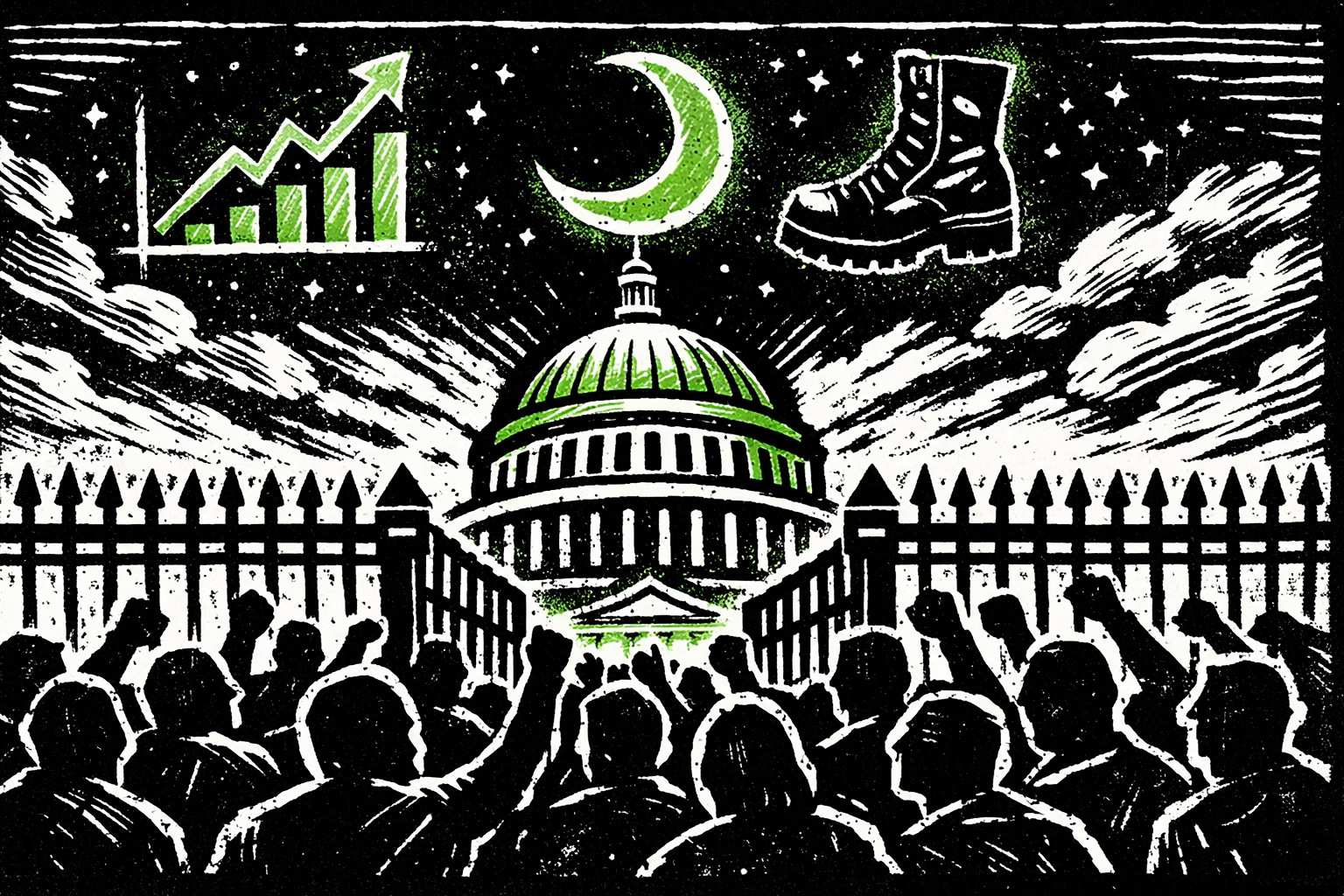
In a week that compressed a year’s worth of political drama into seven days, Nigeria fought over the soul of its electoral system, watched its stock market hit all-time highs, and welcomed American soldiers onto its soil for the first time in years. Each development reflects a country simultaneously reforming its democracy, stabilising its economy, and rewriting its security doctrine — not always in ways its citizens would have chosen.
Table of contents
Politics and governance
The Electoral Act battle tears the National Assembly apart
The House descends into chaos
Tear gas at the gates
INEC sets the 2027 clock—and triggers a Ramadan row
El-Rufai detained, charged, and cornered from multiple angles
Obi rebrands, APC swallows opposition states whole
Economy and business
Inflation hits a sweet spot as food prices plunge
Reserves surge, naira holds firm
Stock market erupts to record highs on pension fund catalyst
Oil, banking, and the revenue drive
Security and defence
American boots on Nigerian ground mark a turning point
A spreading violence problem
Washington sanctions eight Nigerians
Technology, infrastructure, and innovation
Power grid wobbles as maintenance exposes structural fragility
Port clearance goes digital
Aviation incident raises Boeing questions
International relations
Nigeria wins an African Central Bank seat and eyes the UN Security Council
The UAE deal and a royal invitation
ECOWAS’ enforcement gap laid bare
Nigerians warned off foreign battlefields
Society and culture
Ramadan begins — and immediately complicates everything
Nollywood’s Valentine triumph
The Super Eagles’ World Cup fate hangs in the balance
The week ahead
Politics and governance
The Electoral Act battle tears the National Assembly apart
The most consequential political story of the week was a bitter, multi-day confrontation over Clause 60(3) of the Electoral Act Amendment Bill, which governs whether electronic transmission of polling-unit results should be mandatory or discretionary. The fight spilled from the chamber floor into the streets, culminating in tear gas and a legislative walkout.
The Senate had finalised its position by mid-week, approving all 155 clauses of its version but inserting a “safety valve” allowing manual Form EC8A to take precedence if technology fails. Senate Leader Michael Opeyemi Bamidele defended the decision with infrastructure data: Nigeria’s broadband coverage stands at only 70%, internet penetration at 44.53%, and nationwide electricity delivery is limited to roughly 4,500 MW despite a nominal generation capacity of 12,000–13,500 MW. On February 17, the Senate also reduced the mandatory election notice period from 360 to 300 days, after realising the original timeline could force the February 2027 presidential vote into the middle of Ramadan.
The House descends into chaos
The House of Representatives descended into pandemonium that same day. Hon. Francis Waive (APC, Delta), chairman of the House Committee on Rules and Business, moved to rescind the House’s December 2025 passage of a bill mandating real-time electronic transmission, seeking to align with the Senate’s weaker version. When Speaker Tajudeen Abbas ruled the motion carried despite the “nays” being audibly louder, opposition members staged a walkout. The House ultimately passed the Electoral Act 2026 in the session that followed, though an aggrieved lawmaker told The Punch: “They have doctored the Electoral Act, but whatever they brought here will not be considered. Members are angry.” A 12-member joint conference committee was appointed to harmonise the Senate and House versions within one week.
Tear gas at the gates
Outside the National Assembly, the #OccupyNASS movement had camped for four consecutive days demanding mandatory e-transmission. On February 17, police fired tear gas on peaceful demonstrators including former Education Minister Oby Ezekwesili, activist Omoyele Sowore, and former presidential candidate Adewole Adebayo. Sowore declared it “a total declaration of war on Nigerians.” The House vowed to probe the use of force.
The underlying tension is familiar: electronic transmission was at the heart of Nigeria’s 2021 Electoral Act debate and is widely credited with reducing manipulation in the 2023 elections. Critics of the new legislation fear that restoring discretion will reopen a window that took a generation to close.
INEC sets the 2027 clock—and triggers a Ramadan row
On February 13, INEC Chairman Professor Joash Ojo Amupitan formally released the 2027 election timetable. Presidential and National Assembly elections are set for Saturday, February 20, 2027; governorship and state assembly polls for March 6, 2027. Party primaries will run from July through September 2026, with continuous voter registration opening in April. INEC’s total budget for the 2027 cycle stands at ₦873.8 billion, with an additional ₦171 billion for 2026 operations.
The announcement immediately ignited controversy: February 20, 2027, falls squarely within Ramadan (expected February 7–March 8, 2027). Former Vice President Atiku Abubakar and Muslim groups criticised the scheduling. Samson Itodo of Yiaga Africa warned that while elections might be moved to January, altering timelines on religious grounds could create precedents Nigeria would regret. President Tinubu also sent the Senate a nomination requesting confirmation of Retired Admiral Jamila Abubakar Sadiq as a new INEC National Commissioner — a move whose timing, with the electoral law still unsettled, did not go unnoticed.
El-Rufai detained, charged, and cornered from multiple angles
Former Kaduna Governor Nasir El-Rufai faced a dramatic week of legal peril on two simultaneous fronts. On February 12, DSS operatives attempted to arrest him at Abuja airport upon arrival from Cairo; his international passport was seized. The next day, he appeared on Arise TV and made the explosive claim that he and associates had intercepted the phone communications of National Security Adviser Nuhu Ribadu: “Ribadu made the call, because we listened to their calls. The government thinks that they are the only ones who listen to calls.”
The admission triggered swift consequences. On February 16, the Federal Government filed a three-count criminal charge (FHC/ABJ/CR/99/2026) under the Cybercrimes Act 2024 and the Nigerian Communications Act 2003, accusing El-Rufai of unlawful interception, failure to report perpetrators, and using technical equipment to compromise national security. That same day, he honoured an EFCC invitation and was detained overnight for questioning over a separate probe into the alleged misappropriation of ₦423–432 billion in loans during his governorship (2015–2023). Two parallel investigations — one intelligence, one financial — are now underway. El-Rufai’s supporters describe the proceedings as a political vendetta; the government insists due process is being followed.
Obi rebrands, APC swallows opposition states whole
Peter Obi formally broke with the Labour Party on February 16, launching “Operation Rescue Nigeria” in Enugu and aligning his “Obidient” movement with the African Democratic Congress (ADC). The reorganised party installed former Senate President David Mark as national chairman and former Osun Governor Rauf Aregbesola as national secretary. Labour Party called his departure a “liberation.”
The APC’s gravitational pull continued to consume opposition ranks. The party now controls approximately 29–30 of Nigeria’s 36 states. Kano Governor Abba Kabir Yusuf, who defected from NNPP in January, held a massive rally at Sani Abacha Stadium this week. Adamawa Governor Ahmadu Fintiri (PDP) hinted heavily at defection during President Tinubu’s visit to Yola on February 16: “If that is the wish of my people to defect, I have no choice.” Only four PDP governors remain: Fintiri (Adamawa), Dauda Lawal (Zamfara), Bala Mohammed (Bauchi), and Seyi Makinde (Oyo). At this rate, the PDP’s claim to be a national opposition party will be a legal technicality rather than a political reality by the time primaries open.
Economy and business
Inflation hits a sweet spot as food prices plunge
The National Bureau of Statistics released January 2026 CPI data on February 16, revealing headline inflation fell to 15.10% — down from 15.15% in December 2025 and a dramatic 12.51 percentage points lower than the 27.61% recorded a year earlier. Most striking was food inflation, which plunged to 8.89%, its first single-digit reading in 128 months (since May 2015). Month-on-month headline inflation was actually negative at -2.88%, meaning consumer prices fell outright — an unusual development for a country that spent much of 2024 wrestling with a cost-of-living crisis. Core inflation (excluding food and energy) stood at 17.72%, down 7.55 points year-on-year.
Analysts credit a combination of naira stabilisation, a good harvest season, reduced logistics costs following fuel subsidy rationalisation, and CBN’s tight monetary stance. The politically convenient timing — just as the 2027 campaign season warms up — was not lost on commentators, though the data itself appears robust across multiple categories.
Reserves surge, naira holds firm
CBN Governor Olayemi Cardoso disclosed that net external reserves reached approximately $49 billion as of February 5 — up from roughly $3 billion in net terms when the Tinubu administration took office in May 2023. The naira strengthened throughout the week, with the official NFEM rate moving from ₦1,353.25/$ on February 11 to ₦1,351.18/$by February 17. The parallel market narrowed to ₦1,420–₦1,435/$, with the official-parallel premium collapsing to under 2% — a signal that the foreign exchange reforms have achieved a durable, if still fragile, convergence. Multiple institutions project GDP growth of 4.0–4.49% for 2026, with the IMF forecasting Nigeria’s nominal GDP will reach $334 billion, overtaking Algeria as Africa’s third-largest economy this year.
Stock market erupts to record highs on pension fund catalyst
The NGX All-Share Index surged to an all-time high of 190,281.57 on February 16, gaining 4.37% in a single session — the fourth such move exceeding 4% since November 2020. Market capitalisation jumped ₦5.11 trillion that day alone to reach ₦122.14 trillion, with a year-to-date return of 22.28%. Over the week ending February 13, the index had crossed 180,000 for the first time, adding ₦6.79 trillion across five sessions.
The primary catalyst was the National Pension Commission’s (PenCom) February 9 decision to raise equity investment limits across pension fund categories: RSA Fund I from 30% to 35%, Fund II from 25% to 33%, and Fund III from 10% to 15%. With total pension assets exceeding ₦26 trillion, CardinalStone Research estimates roughly ₦1 trillion in potential new equity flows under a base-case scenario — a structural liquidity injection, not a speculative one. Market breadth on February 16 showed 54 gainers versus 28 decliners, with Dangote Cement, Oando, and Aradel Holdings each hitting the +10% daily limit. MTN Nigeria’s market cap soared to ₦14.9 trillion, with shares reaching ₦779.70.
Oil, banking, and the revenue drive
NNPC Ltd reported after-tax profit of ₦5.76 trillion (~$4.26 billion) for FY2025, on revenue of ₦60.5 trillion, with average crude and condensate production of 1.62 million barrels per day. Nigerian Breweries posted revenue of ₦1.467 trillion (up 35%), with operating profit growth exceeding 190%. Sterling Financial Holdings confirmed both Sterling Bank and AltBank are fully recapitalised ahead of the March 31 deadline, having injected ₦153 billion — a signal to the market that the CBN’s recapitalisation drive is producing results rather than panic.
The Nigeria Revenue Service set a 2026 collection target of ₦40.7 trillion, a 44% increase from ₦28.29 trillion in 2025. The Debt Management Office announced plans to raise ₦800 billion in a February 23 bond auction — a 128.6% increase from the same month last year — across 7- and 10-year tenors, signalling the government’s intent to lengthen its debt maturity profile even as the fiscal gap remains wide.
Security and defence
American boots on Nigerian ground mark a security turning point
On February 11, Nigeria’s Defence Headquarters announced that U.S. military personnel would deploy to Nigeria for training and intelligence-sharing. By February 16, approximately ~100–200 U.S. troops plus equipment had arrived — precise numbers varied across U.S. and Nigerian accounts, with Military Times reporting a figure closer to 200. AFRICOM Commander Gen. Dagvin Anderson had met with Chief of Defence Staff Gen. Olufemi Oluyede and Chief of Army Staff Lt. Gen. Waidi Shaibu in Abuja on February 9 to finalise arrangements. The troops will not engage in combat, and Nigerian forces retain complete command authority.
Human Rights Watch immediately called for robust human rights safeguards, citing Nigeria’s documented history of extrajudicial killings, arbitrary detention, and enforced disappearances during security operations. The implicit question — whether American training will improve capability or reinforce existing impunity — is one that previous security partnerships across the Sahel have rarely answered satisfactorily.
A spreading violence problem
The deployment came against a backdrop of alarming breadth. A Vanguard analysis documented 1,258 violent deaths in just 41 days (January 1–February 10), while Bloomberg reported that jihadist violence is migrating southward toward Lagos — a fundamental shift in the geography of Nigeria’s insecurity crisis that previous containment strategies had not anticipated.
On the operational front, suspected Boko Haram and ISWAP fighters launched coordinated attacks on two military positions in Borno State on February 14–15, striking Pulka and Mandaragirau. A senior terrorist commander identified as Abou Aisha was killed, but soldiers and Civilian JTF members also died at Mandaragirau. In Zamfara, 11 bandits died when an IED they were transporting detonated prematurely. Nine children kidnapped from a church in Benue on February 8 were rescued by February 15, with four suspects arrested and an AK-47 recovered. President Tinubu, speaking at a security summit on February 15, declared victory over insurgency “certain” — a confident assertion that battlefield realities this week did not fully support.
Washington sanctions eight Nigerians
The U.S. Treasury’s OFAC sanctioned eight Nigerians on February 16 under terrorism and cybercrime designations, including Boko Haram financier Salih Yusuf Adamu — convicted in the UAE in 2022 for attempting to transfer $782,000 from Dubai to Nigeria for the group — and several Al-Barnawi family members linked to ISWAP. The timing, coinciding with the troop deployment announcement, suggests a deliberate U.S. strategy of pairing capacity-building with financial pressure against the networks sustaining the insurgency.
Technology, infrastructure, and innovation
Power grid wobbles as maintenance exposes structural fragility
Infrastructure vulnerabilities were exposed mid-week when Seplat Energy conducted scheduled gas maintenance from February 12–15, temporarily reducing supply to the NNPC Gas Infrastructure pipeline network and prompting official warnings of low electricity supply for four days. The episode underscored Nigeria’s dependence on gas-fired power generation: installed capacity stands at approximately 13,000 MW but actual delivery to consumers rarely exceeds 4,500 MW. A single operator’s maintenance schedule can meaningfully dim the national grid.
The 2026 federal power budget allocates ₦1.096 trillion in capital spending, with 46% going to the Rural Electrification Agency for mini-grids and decentralised systems — a notable strategic pivot away from the national grid model that has absorbed decades of investment with limited returns.
Port clearance goes digital
The Nigeria Customs Service launched a digital One-Stop-Shop platform on February 16, aimed at slashing cargo clearance times from the current average of 21 days to 48 hours by integrating all port agencies onto a single interface. If the ambition is realised, it would eliminate one of the most frequently cited obstacles to doing business in Nigeria and reduce the informal “facilitation” costs that importers currently factor into their landed price calculations.
Aviation incident raises Boeing questions
An Arik Air Boeing 737-700 flying from Lagos to Port Harcourt on February 11 suffered a major internal failure — likely a fan blade separation — in the left engine at 27,000 feet, forcing an emergency diversion to Benin. All 80 people on board were uninjured. The incident raised questions about fleet maintenance standards at Arik and, more broadly, about Nigeria’s ageing commercial aviation infrastructure. The NCAA opened an investigation.
International relations
Nigeria wins an African Central Bank seat and eyes the UN Security Council
At the 39th AU Summit in Addis Ababa (February 14–15), Nigeria secured a permanent seat on the Board of the African Central Bank — described by Foreign Minister Yusuf Maitama Tuggar as “a landmark development” underscoring Nigeria’s role in shaping Africa’s financial architecture. Vice President Kashim Shettima, who represented President Tinubu at the summit, also used the platform to advocate health security sovereignty, urging African nations to build “resilient, self-sustaining, homegrown health systems.”
A bilateral meeting with UN Secretary-General António Guterres proved diplomatically significant. Guterres endorsed Nigeria’s bid for a permanent UN Security Council seat, stating: “This is 2026 — not 1946. Whenever decisions about Africa and the world are on the table, Africa must be at the table.” He described Nigeria as “uniquely positioned to lead the continent toward superpower status.” At the C-5 Plus Summit on South Sudan, Nigeria called for the immediate release of detained First Vice President Riek Machar and an inclusive national dialogue — a position that keeps Abuja visible in the continent’s most active peace processes.
The UAE deal and a royal invitation
President Tinubu on February 17 lauded the signing of a strategic MoU between BUA Group and UAE-based AD Ports Group and MAIR Group covering sugar refining, agro-industrial development, and logistics. Tinubu’s upcoming State Visit to the United Kingdom on March 18–19, following a formal invitation from King Charles III, was announced during the week — a visit that Nigerian diaspora groups in the UK described as long overdue.
ECOWAS’ enforcement gap laid bare
The ECOWAS Court’s President, on a visit to Abuja on February 17, lamented that 80% of the Court’s judgments cannot be enforced across member states — a structural weakness that undermines the bloc’s credibility as a regional rule-of-law institution. The disclosure came alongside NBS data showing ECOWAS-based investors contributed a negligible 0.01% ($2.16 million) of Nigeria’s $16.78 billion in foreign capital importation for the first nine months of 2025. For a regional body whose principal economic rationale is deeper integration, both figures are damning.
Nigerians warned off foreign battlefields
The Foreign Ministry issued a formal warning against illegal recruitment of Nigerians into foreign armed conflicts, citing deceptive offers linked to the Russia-Ukraine war. The government’s position: participation in foreign conflicts without authorisation carries criminal liability under Nigerian law.
U.S. visa restrictions remain a bilateral irritant, with Nigerian B1/B2 applicants now required to post bonds of up to $15,000 and limited to single-entry, three-month validity — an asymmetry that sits awkwardly alongside the week’s troop deployment and security partnership announcements.
Society and culture
Ramadan begins — and immediately complicates everything
The Sultan of Sokoto directed Muslims to search for the Ramadan crescent on February 17, and it was sighted that evening across multiple locations. Fasting began Wednesday, February 18 — a development that simultaneously adjusted commercial rhythms, deepened the 2027 election-calendar controversy, and reminded policymakers that Nigeria’s religious calendar is as consequential as any legislative one.
Nollywood’s Valentine triumph
Valentine’s weekend belonged to Nollywood. “Love and New Notes”, directed by Kayode Kasum and starring Timini Egbuson, opened on February 13 with an opening weekend gross of ₦106.5 million — the biggest Nollywood opening of 2026 and the first to cross ₦100 million outside December. Its Valentine’s Day single-day take of ₦48 million set a 2026 record. FilmOne Entertainment declared the film “did not just open in cinemas; it kicked the door down.” The figure is a modest number by Hollywood standards, but for a domestic industry that subsistence-farmed its audience through years of piracy and limited screen count, it represents a structural shift in consumer spending on entertainment.
The Super Eagles’ World Cup fate hangs in the balance
Nigeria’s 2026 World Cup qualification remains in legal limbo. FIFA set February 16 as the date for a ruling on Nigeria’s protest against the Democratic Republic of Congo, following a disputed November 2025 qualifier, but no verdict emerged by week’s end. NFF General Secretary Dr. Mohammed Sanusi maintained: “We have a strong case.” A favourable ruling would send the Super Eagles to an intercontinental playoff in Mexico; an unfavourable one would end their World Cup hopes for a second consecutive cycle — a result that would amplify the NFF’s growing governance pressures.
The week ahead
February 19 (Thursday): The Senate is expected to begin screening President Tinubu’s nominee Retired Admiral Jamila Abubakar Sadiq as INEC National Commissioner. The timing will keep election-integrity questions on the legislative agenda.
February 23 (Monday): The CBN’s Monetary Policy Committee convenes for its 304th meeting (February 23–24). With headline inflation at 15.10% and the naira stable, market consensus leans toward a 50–100 basis-point rate cut from 27.50%. A cut would validate the reform narrative; a hold would signal the CBN remains focused on anchoring expectations before the 2027 electoral cycle introduces fresh fiscal pressures.
February 23 (Monday): The DMO’s ₦800 billion bond auction will test market appetite for longer-dated government paper at a moment when pension funds are rotating into equities. Yield movements will signal whether the fiscal and monetary tracks are aligned.
February 23 (Monday): The 12-member joint conference committee on the Electoral Act 2026 faces its one-week deadline for harmonisation. Whether the committee produces a version that satisfies civil society’s demands for mandatory e-transmission, or simply ratifies the discretionary compromise, will determine whether the #OccupyNASS protests resume.
February 24 (Tuesday): FIFA is expected to issue its ruling on Nigeria’s protest against DR Congo over the disputed 2026 World Cup qualifier. A positive outcome sends the Super Eagles to an intercontinental playoff; an adverse one ends their World Cup campaign for 2026.
Rolling deadline — March 31: The CBN bank recapitalisation deadline for international commercial banks (₦500 billion minimum) is six weeks away. Final CBN verification of compliance is intensifying, and the market is watching for any last-minute capital raise announcements or merger signals from institutions that have not yet confirmed their positions.
Wildcard: The onset of Ramadan on February 18 will reshape both economic activity and political messaging. With the 2027 election calendar now formally entangled with the Islamic calendar, every major political development through March will be filtered through a lens of religious sensitivity — in a country where that lens is rarely neutral.
Reporting draws on Nairametrics, Punch, Vanguard, Premium Times, The Cable, Daily Post, ThisDay, Channels Television, Leadership, Daily Trust, allAfrica, Bloomberg, Military Times, Human Rights Watch, CNBC Africa, and official government statements.